




Since 1994 SARO has been protecting plants, machinery and components that handle bulk materials against erosion, abrasion and impact. Here the technical office answers the most frequently asked questions about materials, products, projects and sectors.
Materials
What is the difference between an alumina lining and an anti-wear polymer resin?
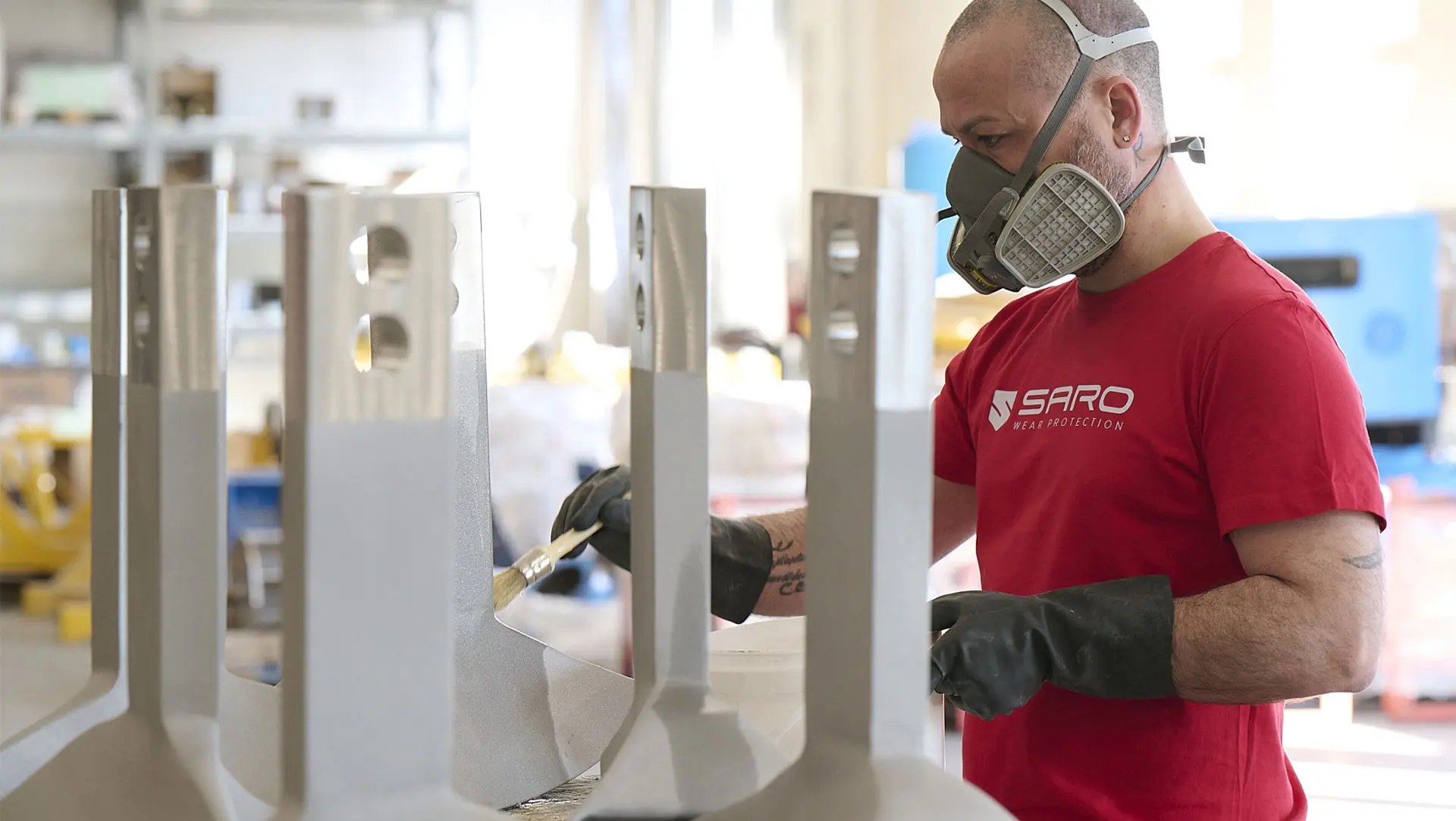
Alumina is chosen where abrasion and erosion prevail, polymer resin where complex geometries need to be rebuilt, blended or protected. SARCER & SARMOS linings are made of 92% alumina, with a hardness of 9 Mohs, but they are rigid and must be carefully evaluated in areas of heavy impact. SARO resins, such as RESINALCERAMICA® T250 A&B and SARPOL RP08, are applied by trowel, including for repairs in the field. The two technologies often coexist in the same plant.
When is an elastomer such as SARCERGOM preferable to ceramic?
When impact is added to abrasion. SARCERGOM consists of alumina elements vulcanised in an anti-abrasion technical rubber matrix: the ceramic resists the sliding of the material, while the rubber (60–65 Shore A) dissipates impact energy and limits vibration and noise. This is why SARO uses it at loading and drop points, in hoppers, chutes and on vibrating screens, where a rigid ceramic tile would need careful evaluation.
→ SARCERGOM & SARCERGOM SHIELD
Can an anti-wear lining contaminate the processed product?
It depends on the sector and the material chosen. Where process cleanliness is critical, as in mixing rare earths for lithium-ion batteries, SARO assesses contamination prevention together with industrial wear protection: in that case it used SARMOS QDR as a barrier and internal tools lined with RESINAL μ50. In the food, glass and battery sectors the material is therefore defined with the SARO technical office, starting from the customer's specifications.
Products
What is SAROMAX100 and how does it differ from a conventional wear plate?
SAROMAX100 is a plate made of two layers: a carbon steel base and a chromium carbide overlay (Cr 34%, 58–65 HRC), fused from powder in the electric arc welding pool. The hard layer resists abrasion, while the base provides the structure. It is suitable for sliding abrasion with medium or moderate impact. It can only be cut by laser or plasma and is also available as parts made to design, such as hoppers, chutes and cyclones.
What are HEXAGON HOSE and TETRAGON HOSE and when are they used?
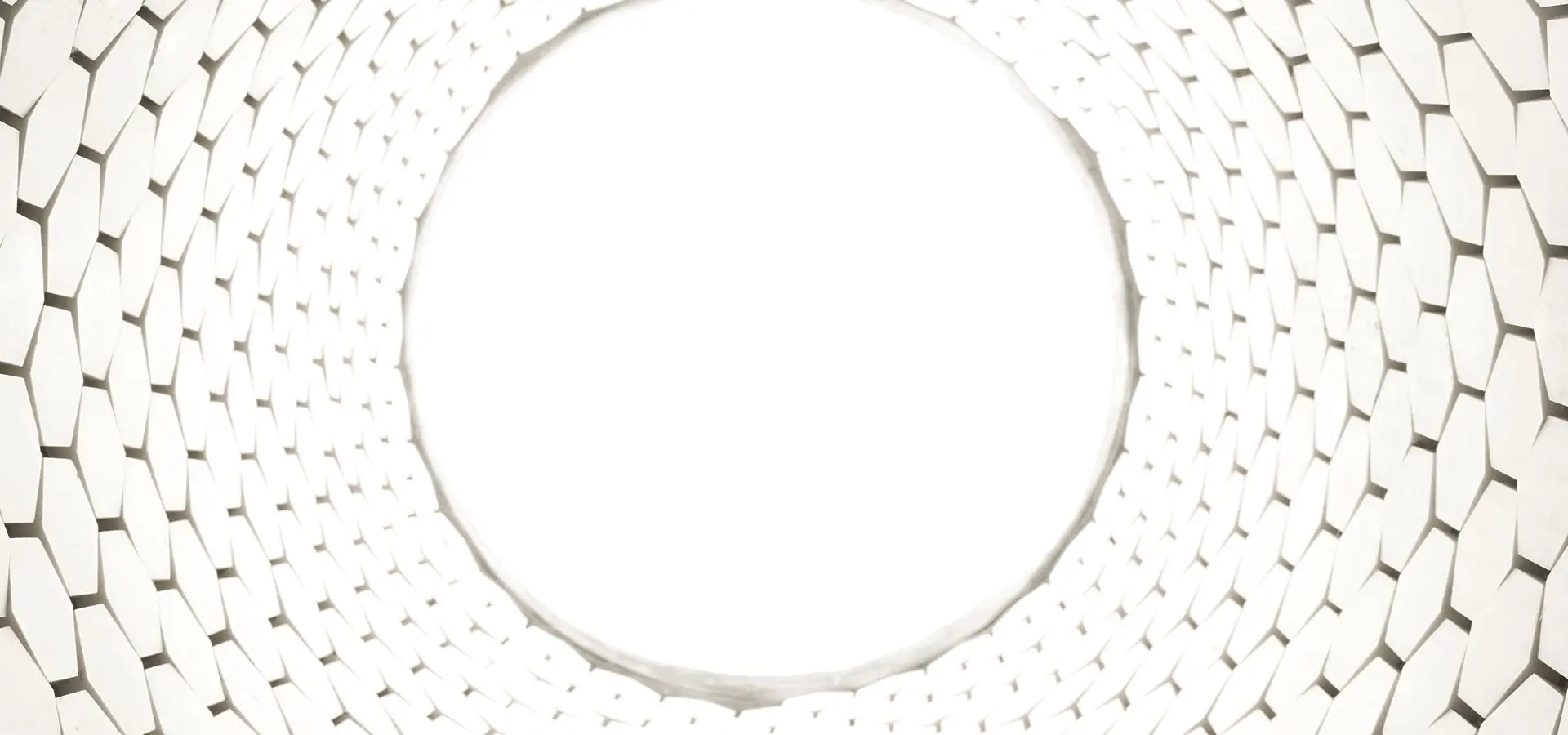
They are rubber hoses with an internal SARCER ceramic lining, designed for the pneumatic conveying of highly abrasive materials, in both pressure and suction lines. HEXAGON HOSE has a hexagonal mosaic with honeycomb layout, TETRAGON HOSE a square mosaic that simplifies installation. Both operate at 10 bar (30 bar burst pressure), between −30 and +70 °C. The SARO data sheet indicates a service life up to 20 times longer than that of an anti-abrasion rubber hose.
→ HEXAGON and TETRAGON compared
What is new from SARO in industrial wear protection?
SARO's latest developments in industrial wear protection are told in SUPERSARO, the comic series on the company blog. Each episode starts from a real plant problem and shows the solution adopted: HEXAGON HOSE for the cement plant burner, TETRAGON HOSE for injection into the electric arc furnace, SAROMAX100 on the steelworks hopper and, for rare earths, SARMOS QDR with tools lined with RESINAL μ50, to combine anti-wear protection and contamination prevention.
Project and quotation
How do you request a custom anti-wear solution, including online?
It starts with a first contact, also online via the form on the Contacts page. The SARO technical office analyses the application, with a site inspection if needed, and prepares a quotation with costs, project description and delivery times. A first assessment requires three sets of information: the handled material (type, particle size, flow rate), the component geometry (photos or drawings, drop heights, residual thicknesses) and the operating history (temperature, previous solutions and their service life).
→ How to choose an anti-wear lining
Can a plant already in operation be protected without replacing the component?
Yes, it is often possible. SARO works on components already installed, applying new linings or carrying out repairs in the field, including directly at the customer's facility. First, however, the steel substrate must be checked: if the steelwork is deformed, cracked or structurally corroded, the lining will not solve the problem and may hide it. Feasibility also depends on access to the critical point and the length of the available shutdown.
→ Internal lining of pipelines
Can several anti-wear technologies be combined in the same plant?
Yes, and it is often the most effective choice, because the industrial wear mechanism changes along the same line. An example of zoning: SARCERGOM at the drop point, SARCER or SARMOS on walls subject to sliding, HEXAGON & TETRAGON HOSE in the flexible sections of pneumatic conveying lines and a filled resin for fittings and repairs. SARO defines the combination only after identifying the prevailing phenomenon at each point.
How long does an anti-wear lining last?
There is no single value: service life depends on the handled material, the speed and angle of impact, the temperature and the technology chosen. According to data published by SARO, a plant protected with its linings lasts on average 5 times longer, and up to 10 times longer with some of the most advanced solutions. These are average values, not guarantees: SARO verifies actual service life by monitoring the application over time.
Sectors
In which sectors and applications does SARO work?
SARO protects plants that handle and process bulk materials, including cement plants, the steel industry, foundries, coal power plants, paper mills, waste-to-energy plants, recycling plants, the food industry and batteries. The most frequent applications are pneumatic conveying and its bends, hoppers, channels and chutes, cyclones, mills and crushers, and silos. More than the sector, however, what matters is the industrial wear phenomenon present at each point.
Is SARO certified and where does it operate?
Yes: SARO works with an ISO 9001:2015 certified quality system and on every supply it inspects the steelwork, the materials and the application process. Its operational headquarters is in Arconate (MI). In Italy the company operates through agents in Lombardy, Liguria, Piedmont, Emilia-Romagna and the Triveneto area; it has been exporting since 2012 and has a Sales Account dedicated to Germany, Austria and German-speaking Switzerland.
Do you have a component that wears out too quickly? Request a technical assessment