




RESINAL μ50
Silicon carbide anti-abrasion epoxy coating
RESINAL μ50 is a two-component epoxy coating filled with Silicon Carbides, developed for anti-wear applications with high abrasion resistance.
The silicon carbide fill gives the coating high performance against:
- high-velocity flow erosion
- continuous abrasion
- localised wear
The system can be applied to:
- metal surfaces
- concrete
- fibreglass
- composite materials
RESINAL μ50 is particularly suitable for:
- pneumatic conveying lines
- bends and piping subject to erosion
- cyclones and separators
- hoppers and impact points
The formulation ensures high protective performance; controlled addition of solvent is also possible to facilitate spray applications on complex or large surfaces.


TYPICAL POLYMERISATION PERFORMANCE
Technology | Epoxy |
Chemical Type | Epoxy |
Appearance (Resin) | Grey Liquid |
Appearance (Hardener) | Grey Liquid |
Appearance – Mixture | Grey Liquid |
Components | 2 parts – Resin & Hardener |
Mixing Ratio (Weight) Resin: Hardener | 2.5 : 1 |
Polymerisation | At ambient temperature after mixing |
Application | Anti-Wear Coating |
Application Temperature | 15 – 30°C |
Operating Temperature | 80°C |
Advantages | Excellent Abrasion Resistance |
TYPICAL CHARACTERISTICS OF MATERIALS
Resin | |
Specific Weight @ 25 °C | 1.7 |
Hardener | |
Specific Weight @ 25 °C | 1.37 |
Mixed | |
Specific Weight @ 25 °C | 1.61 |
Flash Point °C | >110 |
Hardening Properties | |
Working Time (200 g mass), ISO 9514, minutes | 30 |
Overcoating time, at 25 °C, hours | 1–24 |
Time until touch dry, at 25 °C, hours | 4 |
Initial cure time, at 25 °C, hours | 24 |
Full curing (polymerisation) time, at 25 °C, hours | 72 |
Coverage | |
Trowel/Brush application, minimum thickness 500 microns | coverage 1.25 m² / kg, excluding wastage |
Spray application with max. dilution 10%, minimum thickness 300 microns | coverage 1.77 m² / kg, excluding wastage |
Dilution | For spray applications, dilute with M.E.K. or Acetone max 10% by volume; wait at least 1 hour between coats. |
GENERAL INFORMATION
This product is not recommended for use in oxygen-rich and/or pure oxygen systems and should not be selected as a sealant for chlorine or other strong oxidising materials.
For information on the safe handling of this product, consult the safety data sheet (SDS).
INSTRUCTIONS FOR USE
Surface Preparation
Surface preparation is important for the long-term performance of the product. The parameters can vary depending on the severity of the application, expected service life, and initial conditions of the substrates to be treated.
- Remove any dirt, oil, grease etc. with a suitable detergent.
- Any irregularities, weld splashes or residue, and any other surface roughness must be levelled and ground smooth; any depressions or porosity must be filled and ground smooth. All protrusions, edges or joints must be levelled to a minimum radius of 3 mm and all corners must also be rounded to the same specifications.
- Blast the entire surface to be treated with angular grit until you achieve roughness of 50-70 microns, and near-white metal blast cleaning level (SIS SA 2½ /SSPC-SP 10). For immersion applications, a white metal blast cleaning (SIS SA 3/SSPC-SP 5) level is required.
- After abrasive blasting, the metal surface must be cleaned with a cleaner which does not leave residue, or with a solvent, to remove dust and contaminants. Clean, dry compressed air can also be used to remove dust and contaminants. The surface must be coated before any new oxidation occurs.
Method of Application:
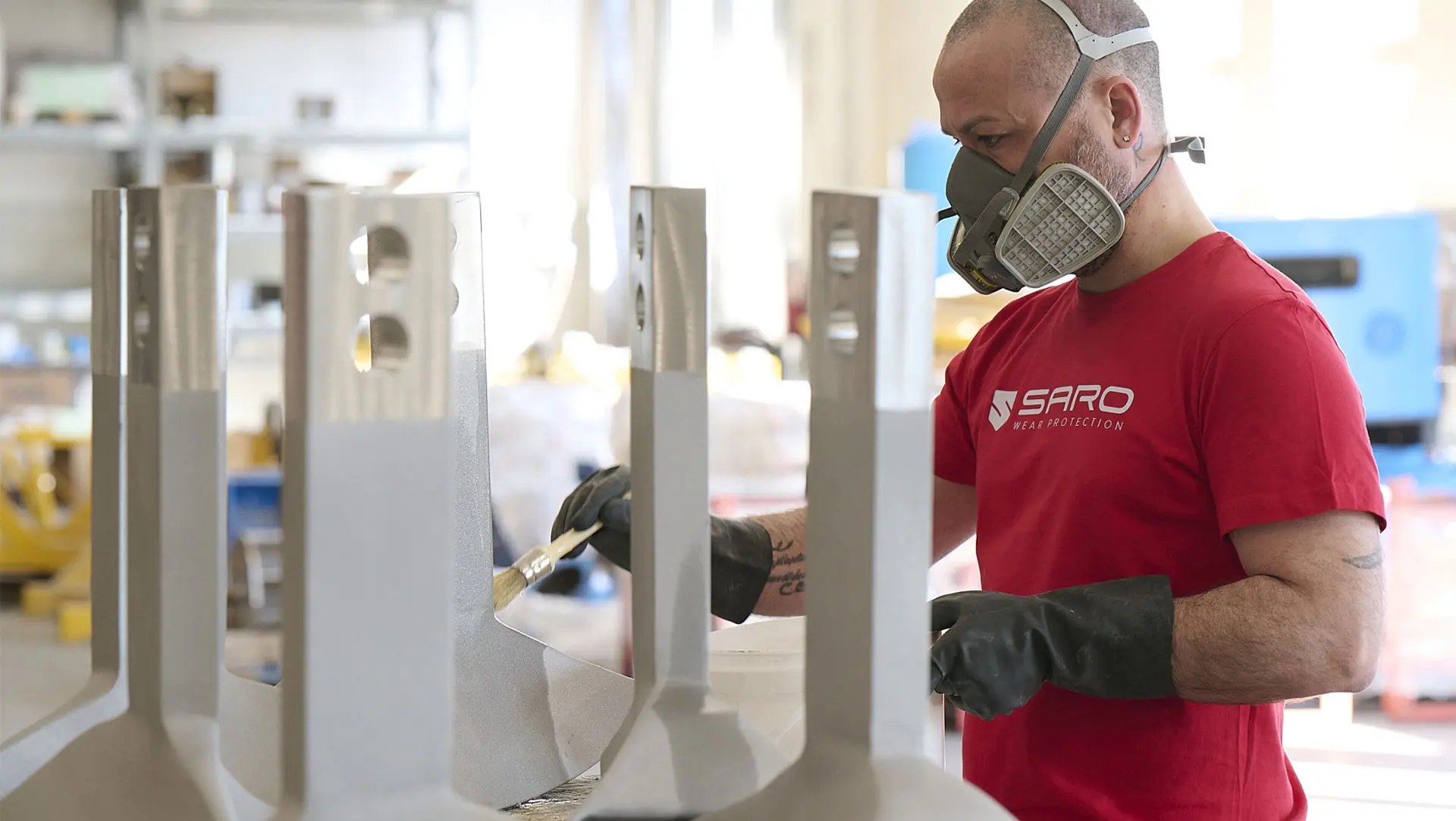
- Film thickness for coating: 200-300 microns. It is recommended to apply a minimum of 2 layers to avoid micro-pitting.
- Application temperature (surface and ambient): 15-30 °C.
- Relative humidity: <85%; The surface temperature must always be at least 3 °C above the dew point.
- Spray systems:
- Airless sprayer for abrasive two-pack products with compression ratio of at least 60:1.
- Nozzle: 3-4 mm; fan 50-60°, depending on the area to be coated.
- Nozzle pressure: 210 bar minimum. Product temperature ≥25 °C.
Subsequent coats must be applied once the product layer has gelled but not cured, within the “overcoating time”. If this time is exceeded, lightly abrade the surface and clean it with a solvent to remove residues.
Check:
- Perform a visual check as soon as application is complete to ensure there is no untreated porosity.
- Once the coating has cured, repeat the visual inspection to confirm the absence of untreated areas, porosity, or mechanical damage.
- Check the coating thickness, especially in critical areas.
Repairs
Any untreated area or porosity, or zone with insufficient thickness, that is detected must be restored or repaired by applying additional product, after light abrasion and surface cleaning.
Cleaning
Clean the equipment immediately after use with a solvent such as acetone or isopropyl alcohol. Once hardened, the product can only be removed mechanically.
2
Not for Product Specifications
The technical data contained herein is for reference purposes only. Please contact the technical department for assistance and recommendations regarding specifications for this product.
Storage
Store the product in the closed container in a dry place. Storage information may be indicated on the product container's label.
Optimal storage: 8 to 21 °C. Storage below 8 °C or above 28 °C may negatively affect the product's properties. Material removed from containers may become contaminated during use. Do not return product to the original container. SARO Srl cannot assume responsibility for product that has been contaminated or stored under conditions other than those indicated above. If further information is required, please contact technical support or your local representative/vendor.
Disclaimer
The information provided in this technical data sheet (TDS), including recommendations for the use and application of the product, is based on the manufacturer's knowledge and experience as of the date of this TDS. The product may have a variety of different applications, as well as different application and working conditions in the environment of use beyond the manufacturer's control. SARO Srl, therefore, is not responsible for the suitability of the product for the production processes and conditions for which it is used, nor for the intended applications and results. It is strongly recommended to conduct your own tests to confirm its suitability. Any liability relating to the information contained in the technical data sheet or any other written or oral recommendation regarding the product is excluded.
SARO Srl expressly disclaims all express or implied warranties, including warranties of merchantability or fitness for a particular purpose, arising from the sale or use of SARO Srl products. SARO Srl expressly disclaims any liability for consequential or incidental damages of any kind, including lost profits.


