




Summary
Welcome to SARO's information space. In this section, we share the latest company news, application case studies, and technical insights into industrial wear protection technologies. Discover how our advanced solutions in ceramic, polyurethane, rubber, and polymer resins can solve abrasion and erosion problems, improving the efficiency and lifespan of your equipment.
This article explores the best ways to protect industrial assets from the main causes of wear, abrasion, and erosion. It will analyze the exceptional characteristics of SARO’s 92% alumina ceramic linings, highlighting their strategic value in reducing total cost of ownership (TCO) and ensuring the operational continuity of plants.
Protecting industrial assets from wear and tear is not merely a routine maintenance task: it means ensuring the operational availability of equipment, the consistency of production cycles, and the safety of personnel. The 92% alumina ceramic is currently one of the most effective engineering solutions for processes characterized by severe abrasion and erosion, provided that the thickness, geometry, and fastening system are sized according to actual operating conditions. SARO’s technical approach integrates tribological analysis, selection of the wear-resistant coating, and expert installation, with the primary goal of extending the service life of components and drastically reducing the total cost of ownership (TCO).
Why do industrial plants wear out? Abrasion and erosion mechanisms
The wear of industrial components is the direct result of continuous interaction between the handled material, the internal surface of the system, and operational process variables. In most applications, multiple degradation mechanisms act simultaneously, requiring careful preliminary diagnosis:
- sliding wear The hard particles flow parallel to the wall, exerting a micro-cutting action and progressive material removal.
- Impact erosion Solid particles strike the surface at high speed, transferring kinetic energy and generating microfractures, chipping, and plastic deformations.
The incidence of these phenomena varies significantly based on the impact angle, particle size, flow rate, drop height, and operating temperature. Neglecting these factors inevitably leads to localized perforations, unscheduled shutdowns, and costly extraordinary maintenance interventions.
Why is 92% alumina ceramic the ideal wear-resistant solution?
Sintered alumina (alpha-alumina) combines extremely high surface hardness with excellent dimensional stability and resistance to chemical attack. SARO technical coatings have an Al₂O₃ concentration of 92% and a hardness of 9 on the Mohs scale (second only to diamond), providing a virtually impenetrable barrier against the abrasive action of clinker, minerals, ash, sand, and heavy dust.
Unlike traditional steel armor or anti-wear plates, technical ceramics are not subject to oxidation or wet corrosion phenomena and maintain their mechanical characteristics unaltered over a wide thermal range. Within the SARO range, the two core solutions meet distinct geometric needs:
- SARCER Lines flat or shaped ceramic tiles with holes for mechanical fastening or welding, ideal for hoppers, chutes, flat walls, and high-flow channels.
- SARMOS Lines: ceramic tiles assembled on a mesh or flexible mosaic backing, designed to line tight-radius curves, pneumatic transport piping, cyclones, and complex geometries.
Engineering note: Hardness alone does not guarantee resistance in the presence of violent impacts. In areas subject to direct impacts of medium-large sized pieces, the ceramic must be coupled with elastic matrices capable of dissipating the impact, as in hybrid panels Sarc-ergom.
Industrial application areas of alumina coatings
Alumina ceramic finds a strategic application in all heavy industry sectors where the continuous handling of bulk solids compromises asset durability:
- Cement and steel industry: clinker chute linings, flue gas ducts, separation cyclones, blast furnace discharge hoppers, and channels subject to high temperatures.
- Caves, mines and mineral processing: internal protection of storage silos, conveyor belt loading points and vibrating feeders.
- Pneumatic conveying and dust collection: bends, flow diverters, elbows, and centrifugal separators exposed to concentrated erosion due to the change in trajectory of the powders.
- Waste treatment and recycling plants: surfaces in contact with heterogeneous abrasive materials and shredded scrap.
The advantages on TCO and business continuity
The adoption of alumina wear-resistant linings makes it possible to transform plant management from a reactive model to a preventive and predictive maintenance model. Although the initial investment for a ceramic lining may be higher than that of commercial sheet metal, the calculation of the Total Cost of Ownership (TCO) demonstrates the extraordinary cost-effectiveness of ceramics:
- Service life extension: from 3 to over 10 times higher than standard metals under the same sliding wear conditions.
- Elimination of unscheduled stops: Surface regularity prevents clogging and sudden punctures.
- Labor cost reduction: lower frequency of dismantling, welding, and restoration operations in confined spaces.
Technical studio and installation: the importance of resins and structural adhesives
The durability of an alumina ceramic lining depends largely on the quality of the fastening system and the preparation of the metal substrate. Depending on the temperature parameters and the chemical-mechanical stresses, SARO designs the installation by combining proprietary technical adhesives:
- SAROPLAST A&Btwo-component structural epoxy adhesive with extremely high toughness, specifically formulated for the rigid bonding of plates and mosaics onto metal substrates up to 150 °C.
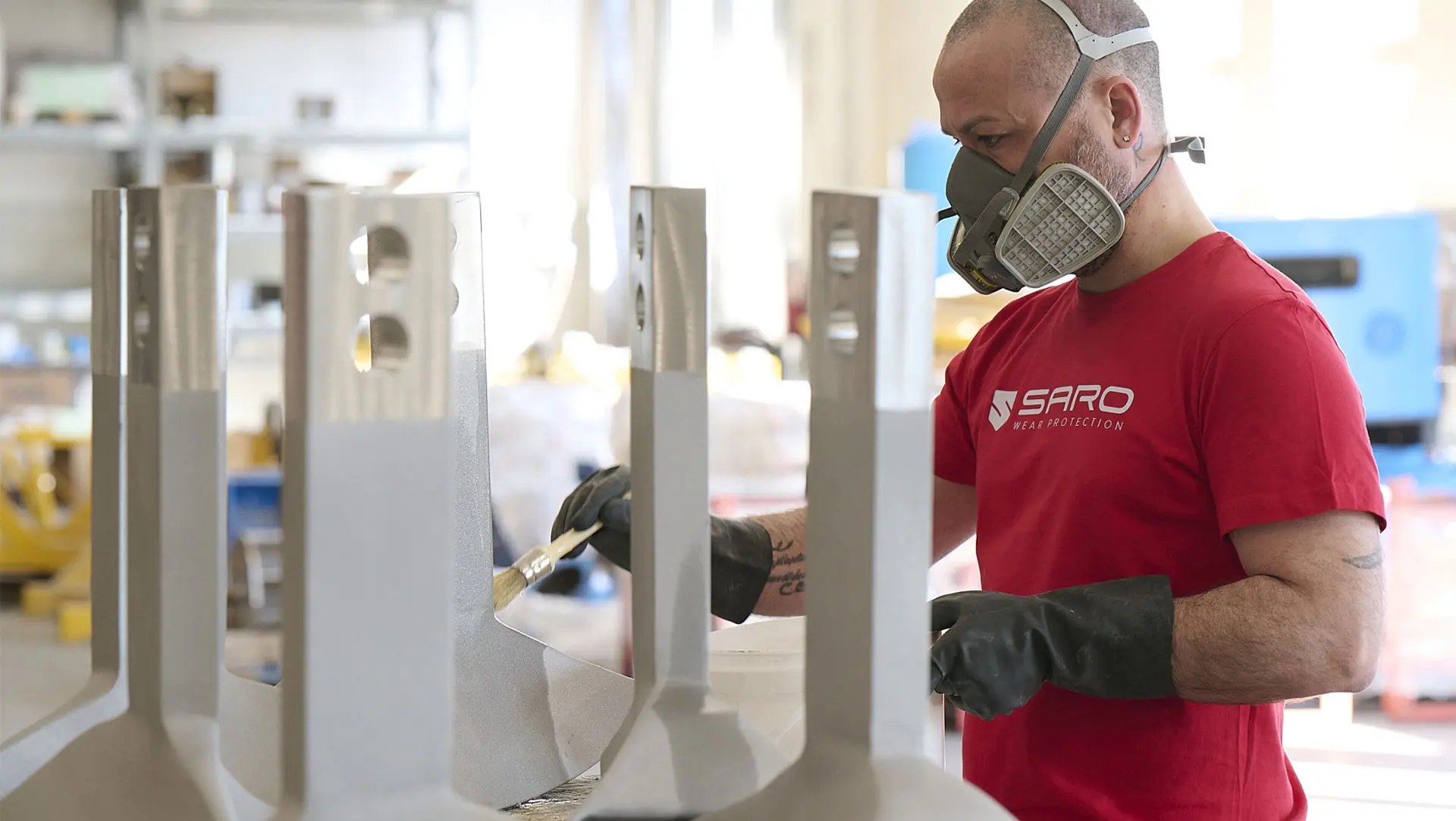
- RESINALCERAMICA T250 A&Bepoxy paste loaded with ceramic micro-particles, ideal for sealing tile joints, protecting bolt heads, and rapidly rebuilding deteriorated metal parts prior to installation.
Frequently Asked Questions (FAQ) about Alumina Ceramic Linings
What is the recommended thickness for alumina tiles?
There is no universal thickness. The SARO range includes standard thicknesses from 3 to 25 mm. For fine powders at low speed, 6-10 mm may be sufficient; for high flow rates or aggressive particle sizes, thicknesses of 15-25 mm are used.
Is it possible to cut and shape alumina directly on-site?
Yes, by using professional water-cooled diamond blades. However, to guarantee maximum geometric precision and reduce installation times, SARO supplies pre-cut plates and custom special pieces made directly at the factory.
What is the maximum temperature supported by the coating?
The alumina ceramic tile withstands over 1000 °C. The operating limit of the assembly is determined by the adhesive: the SAROPLAST A&B epoxy adhesive operates safely up to 150 °C. For higher temperatures, SARO uses mechanical fastening systems using welded studs and protective ceramic caps.
When is it better to choose rubber-ceramics compared to alumina alone?
When abrasive wear is accompanied by vertical impacts of coarse material (e.g., falling from a belt from a height of more than 1 meter), in this case the SARCERGOM panel absorbs the kinetic energy while safeguarding the integrity of the ceramic.
Do you want to analyze the wear signature of your system? Contact the SARO technical office for a personalized study and on-site preventive consultation.