





Summary
Welcome to SARO's information space. In this section, we share the latest company news, application case studies, and technical insights into industrial wear protection technologies. Discover how our advanced solutions in ceramic, polyurethane, rubber, and polymer resins can solve abrasion and erosion problems, improving the efficiency and service life of your equipment.
Summary
The article explains why in pneumatic conveying abrasive materials, such as cement and clinker, ashes, sands, glass and recycled materials, curves and pipes wear out much faster than expected, especially in turns and at high speeds.
It presents the three families of anti-wear solutions used by SARO: alumina ceramic linings such as SARCER BENDS & PIPES, hybrid rubber + ceramic solutions such as the HEXAGON & TETRAGON HOSE flexible hoses, and loaded resins such as RESINALCERAMICA® T250 A&B and SARPOL µ50 for localised repairs and protection.
Finally, it describes the method SARO in four stages: analysis of the points wear, selection of the most suitable technology, implementation in the plant, and monitoring over time.
Contents
What pneumatic conveying is and why abrasive materials cause wear in pipelines and bends
Pneumatic conveying is one of the most widespread technologies in industrial plants: it allows bulk materials—powders, granules, fine aggregates—to be moved inside pipelines using pressurised or vacuum air, in dilute or dense phase. Simple in principle, but far from simple to manage when the materials being conveyed are highly abrasive. It is precisely in these contexts that wear becomes a concrete problem, with bends and pipelines wearing out much faster than expected, leading to unplanned plant shutdowns and maintenance costs that are difficult to control. In our experience at SARO, the sectors where these critical issues emerge most frequently are:
- Cement plants;
- Coal-fired power plants;
- Foundries and metalworking;
- Plants for recycling and processing bulk materials.
The materials transported in these plants are often among the most aggressive that exist:
- Cement and clinker;
- Ash and pulverised coal;
- Sand, quartz, and mineral aggregates;
- Ground glass and demolition materials;
- Products from recovery and recycling with high content of hard fractions.
When these materials travel at high speed within pipes, the combined action of erosion, abrasion, and impact progressively consumes the internal walls. Every change in direction concentrates the stress from the continuous flow of material on the line's components: each bend thus creates a weakness that affects subsequent straight sections, causing thinning and perforations that occur much sooner than expected.
Adjusting fluid dynamics parameters—switching from a dilute to a dense phase, reducing velocities, and regulating flow rates—helps mitigate the problem, but rarely resolves it entirely. When the combination of material properties, operating conditions, and line geometry is critical, wear persists. For this reason, at SARO, our approach is to intervene precisely where the flow exerts the greatest stress on the walls, with protective devices sized according to the actual conditions of each system—whether it be pneumatic, mechanical or other conveying systems.
Types of wear-resistant linings and inserts for pneumatic conveying systems
When managing wear in a pneumatic conveyor line, the first question to ask is: where is the most wear occurring? In most cases, the trouble spots are always concentrated in the same places:
- Large and small radius bends;
- Frequent changes in direction;
- Sections where the flow travels at high speed;
- Areas where the material arrives with force — discharges, joints, constrictions.
In our experience, for each of these critical points we have identified three families of anti-wear solutions to rely on:
- Alumina ceramic linings;
- Hybrid rubber + ceramic solutions;
- Filled resins for repairs and localised protection.
In SARO, these technologies are grouped into dedicated application areas—pneumatic conveying and protective coatings—our concrete starting point for building the most suitable solution for each plant.
Alumina ceramic coatings
Among the materials we use the most for protecting pneumatic transport lines, the technical ceramics based on alumina they are the ones we rely on the most. Their high hardness and naturally smooth surface make a concrete difference:
- They reduce the risk of perforations and material loss
- They reduce adhesion and buildup along the walls;
- They maintain the cross-section over time, eliminating pressure drops due to the deterioration of the line geometry;
In SARO we use them in various forms, depending on the point to be protected and the geometry of the line:
- Ceramic tiles;
- Preformed segments;
- Shaped inserts for bends and special parts.
The most widespread application of coatings belongs to the family SARCER BENDS & PIPES: a steel structure protecting the internal ceramic lining, designed on the actual operating conditions and needs of the lines. Format, thickness and laying pattern are adapted accordingly to ensure the best result in every application.
Hybrid rubber + ceramic solutions
Abrasion isn't always the only enemy. In many plants we monitor, impacts, vibrations, and mechanical shocks also occur on the pipe walls — and in these cases, ceramic alone is not enough. This is where we at SARO resort to hybrid rubber + ceramic solutions, which allow us to combine wear resistance with the ability to absorb stress:
- Ceramic inserts are embedded in an elastomeric matrix;
- The rubber absorbs shocks and limits the risk of brittle coating fractures;
- The result is wear protection that is more “tolerant” of dynamic stresses.
One of the most concrete examples of this technology in our range are the wear-resistant hoses. HEXAGON & TETRAGON HOSE:
- The rubber hose integrates ceramic inserts with hexagonal or square geometry on the internal surface.;
- The solution combines installation flexibility and high durability even with extremely abrasive materials.;
Filled resins for repair and protection
It often happens that we encounter complex internal geometries, or that we need to quickly intervene on a point that has worn down more than expected. In these cases, waiting for the scheduled stop is not always possible. This is where we at SARO resort to filled resins: epoxy-based formulations with high-hardness ceramic fillers, designed for quick and precise intervention:
- Restore missing volume on worn bends and sections;
- Create localised protective layers.;
- Extend the service life of components until the scheduled shutdown.
In our range, the products we use most often in these contexts are:
- RESINALCERAMICA® T250 A&B, epoxy resin filled with alumina microspheres for surfaces subjected to intense abrasion;
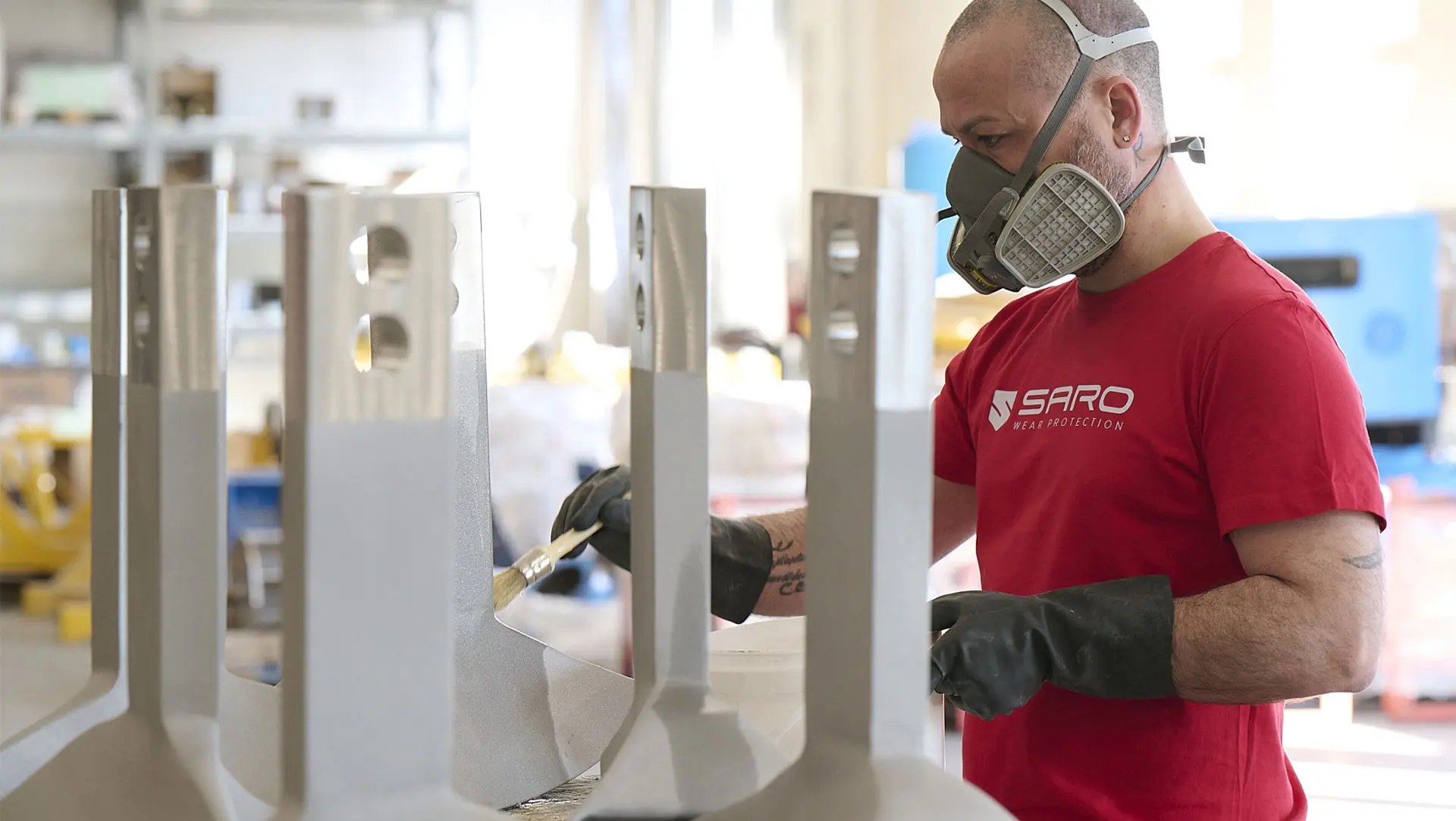
- SARPOL µ50 brushable epoxy resin filled with ceramic powder and carbides to protect worn metal parts
How SARO internal linings for pipes and bends reduce erosion, plant downtime and maintenance costs
The SARO experience shows that wear protection in pneumatic conveying is more effective when it is targeted: you start with the sections that generate the most problems (bends, direction changes, high-speed zones) and dimension materials and thicknesses based on the actual stresses. This allows us to build a Tailored anti-wear strategy for each line. In practice, the protection focuses where the particulate works the hardest on the walls, reducing:
- The replacement frequency of pipes and bends;
- Emergency interventions (patches, welds, urgent replacements);
- Maintenance times, which affect plant availability
Comparison between standard lines and lines with SARO anti-wear solutions
| Aspect | Without specific protections | With SARO anti-wear solutions (ceramic, rubber + ceramic, filled resins) |
| Service life of pipelines and bends | Reduced service life, frequent replacements | Longer service life in critical sections thanks to ceramic coatings and wear-resistant components |
| Maintenance frequency | Recurring interventions, often unscheduled | More predictable maintenance, greater use of scheduled stops |
| Operating continuity | Increased risk of blowouts and unexpected downtime | Increased plant availability, reduction of unplanned downtimes |
| Handling of abrasive materials | Rapid erosion of the most stressed areas | Targeted protections sized according to the intensity of wear experienced |
How SARO identifies the custom anti-wear solution for pneumatic conveying
Choosing the right material is important, but it's not enough on its own. In our experience, a wear protection It really works when there’s a clear method behind it. At SARO, we work in phases, and each phase plays a specific role in the final result.
Analysis of wear points
First of all, we understand what is really happening on the line:
- Survey of the conveyed materials — cement, ash, glass, sand, recycled materials;
- Check of flow rates, velocities, regime (dilute or dense phase) and temperatures;
- Mapping of bends and critical sections, also based on maintenance history.
Selection of the most suitable anti-wear technology
Only after that do we move on to the solution:
- Selection between ceramic, rubber + ceramic and resins;
- Definition of thicknesses, formats, laying patterns, and fastening systems;
- Alignment with plant constraints — spaces, access, available downtime window.
Implementation and integration into the plant
The solution takes concrete shape:
- Supply of pre-lined bends and pipes such as SARCER BENDS & PIPES;
- Use of HEXAGON & TETRAGON HOSE ceramic-lined hoses in moving sections;
- Application of linings with filled resins.
Monitoring over time
The supply of components is just the starting point.
- Periodic inspection of protected areas to detect wear variations;
- Optimisations or extensions of covered areas based on actual operational data.
Request a custom anti-wear solution for your pneumatic conveying lines
Reducing wear in a pneumatic conveying line handling abrasive materials is not a matter of luck — it is a matter of diagnosis. You need to know where the line wears most (bends, high-velocity sections, flexible connections) and match those points with the technology best suited to the actual operating conditions. This is exactly how we work at SARO, where the pneumatic conveying and protective lining product families are the basis from which we build ceramic linings, hybrid solutions and filled resins, all tailor-made for each plant.
To arrive at the right solution without risking either under- or over-sizing, the advice we always give is to start with the data: flow rate and transport speed values, and a history of maintenance interventions, are already an excellent starting point.
If you want a free analysis of your plant's critical points, contact our technical teaman expert will respond to you, quickly.
Frequently asked questions
In which sectors is the availability pneumatic conveying of abrasive materials most critical wear?
The main critical issues emerge in:
- Cement plants;
- Coal-fired power plants;
- Foundries and metalworking;
- Mining and inert treatment plants;
- Paper mills and recycling plants for bulk materials with high abrasiveness.
In these contexts, pneumatic lines are often among the areas protected with ceramic linings, ceramic-lined hoses and filled resins from the SARO application portfolio.
Can anti-wear solutions be applied to pneumatic conveying existing lines?
Yes. Existing lines can be protected by:
- Insertion of pre-lined components (ceramic bends and pipes);
- Use of ceramic-lined hoses in the connection areas;
- Field application of filled resins on the most worn areas.
The structure of the pneumatic conveying and protective lining product families makes it possible to work on plants already in service, minimising structural modifications.
How do you choose the type of protection that is best suited for pipes and bends?
The choice depends on parameters such as:
- Conveyed material and particle size;
- Conveying regime (dense or dilute phase);
- Speed and intensity of impacts;
- Temperature and chemical conditions;
- Geometry of lines and installation constraints.
Based on these elements, the lining material (ceramic, rubber + ceramic, filled resins), the thickness and format of the inserts and the fastening system are defined, concentrating protection on the truly critical sections.
Why combine technical ceramics, rubber and loaded resins into a single anti-wear strategy?
A strategy that combines:
- Technical ceramics in areas subject to high abrasion;
- Rubber + ceramic where impacts and vibrations are present;
- Filled resins for restorations and complex geometries.
allows for protection to be adapted to each line segment. The result is more precise wear control, with fewer unexpected downtimes and more predictable maintenance throughout the plant's lifecycle.