





Summary
Welcome to SARO's information space. In this section, we share the latest company news, application case studies, and technical insights into industrial wear protection technologies. Discover how our advanced solutions in ceramic, polyurethane, rubber, and polymer resins can solve abrasion and erosion problems, improving the efficiency and lifespan of your equipment.
Pneumatic conveying is a method of transporting bulk materials using a gas, typically air, as the conveying medium. This is achieved by introducing the material into a stream of air moving at high velocity through a pipe. The air stream carries the material along the pipe to its destination.Abrasive materials generate wear in pipelines and bends because of the friction and impact that occur between the material particles and the pipe's inner surface. Here's a breakdown of why this happens:* **Friction:** As the abrasive particles move through the pipeline, they rub against the inner walls. This constant friction acts like sandpaper, gradually eroding the material of the pipe. Highly abrasive materials have sharp edges or a hard composition that exacerbates this abrasive action. * **Impact:** When materials, especially at high speeds, navigate bends in the pipeline, they tend to impact the outer wall of the bend. This repeated impact puts significant stress on the pipe material, leading to deformation, erosion, and eventually failure. The sharper the bend and the higher the velocity of the material, the greater the impact force and subsequent wear. * **Particle Velocity and Density:** The faster the abrasive particles travel, the more kinetic energy they possess. This higher energy translates to more forceful impacts and increased friction, leading to accelerated wear. Denser materials also exert more pressure on the pipe walls due to their weight. * **Material Properties:** The type of abrasive material itself is a primary factor. Harder and sharper materials like silica, sand, or certain minerals will naturally cause more wear than softer, rounded materials. * **Pipeline Geometry:** Bends, particularly sharp 90-degree elbows, are areas of high wear. As the material changes direction, it's forced to exert more pressure against the pipe walls. Tees and other flow disruptions can also create turbulence and impact points that accelerate wear. * **Flow Characteristics:** The "carrying medium" (air) velocity and pressure play a role. If the air velocity is too high for the material being conveyed, it can lead to excessive turbulence and particle impingement, increasing wear. Conversely, if the velocity is too low, the material may settle and cause blockages, which can also lead to localized wear.Over time, this continuous abrasion and impact can significantly degrade the pipeline, leading to thinning of the walls, pinhole leaks, and ultimately the need for repair or replacement.
Pneumatic conveying is one of the most widespread technologies in industrial plants: it allows bulk materials—powders, granules, fine aggregates—to be moved inside pipelines using pressurized or vacuum air, in dilute or dense phase. Simple in principle, but far from simple to manage when the materials being conveyed are highly abrasive. It is precisely in these contexts that wear becomes a concrete problem, with bends and pipelines wearing out much faster than expected, leading to unplanned plant shutdowns and maintenance costs that are difficult to control. In our experience at SARO, the sectors where these critical issues emerge most frequently are:
- Cement plants;
- Coal-fired power plants;
- Foundries and metalworking;
- Plants for recycling and processing bulk materials.
The materials transported in these plants are often among the most aggressive that exist:
- Cement and clinker;
- Coal ash and coal dust;
- Sand, quartz, and mineral aggregates;
- Ground glass and demolition materials;
- Products from recovery and recycling with high content of hard fractions.
When these materials travel at high speed within pipes, the combined action of erosion, abrasion, and impact progressively consumes the internal walls. Every change in direction concentrates the stress from the continuous flow of material on the line's components: each bend thus creates a weakness that affects subsequent straight sections, causing thinning and perforations that occur much sooner than expected.
Adjusting fluid dynamics parameters—switching from a dilute to a dense phase, reducing velocities, and regulating flow rates—helps mitigate the problem, but rarely resolves it entirely. When the combination of material properties, operating conditions, and line geometry is critical, wear persists. For this reason, at SARO, our approach is to intervene precisely where the flow exerts the greatest stress on the walls, with protective devices sized according to the actual conditions of each system—whether it be Pneumatic transportI, mechanical or otherwise.
Types of wear-resistant linings and inserts for pneumatic conveying systems
When managing wear in a pneumatic conveyor line, the first question to ask is: where is the most wear occurring? In most cases, the trouble spots are always concentrated in the same places:
- Large and small radius curves;
- Frequent changes in direction;
- Sections where the flow travels at high speed;
- Areas where the material flows with force—drains, junctions, narrowings.
In our experience, for each of these critical points we have identified three families of anti-wear solutions to rely on:
- Alumina ceramic linings;
- Hybrid rubber + ceramic solutions;
- Filled resins for repairs and localized protection.
In SARO, these technologies are grouped into dedicated application areas—pneumatic conveying and protective coatings—our concrete starting point for building the most suitable solution for each plant.
Alumina ceramic coatings
Among the materials we use the most for protecting pneumatic transport lines, the technical ceramics based on alumina they are the ones we rely on the most. Their high hardness and naturally smooth surface make a concrete difference:
- They reduce the risk of perforations and material loss
- They reduce adhesion and buildup along the walls;
- They maintain the transition section over time, eliminating pressure losses due to the degradation of the line's morphology.
In SARO we use them in various forms, depending on the point to be protected and the geometry of the line:
- Ceramic tiles;
- Preformed segments;
- Shaped inserts for curves and special pieces.
The most widespread application of coatings belongs to the family SARCER BENDS & PIPESa steel structure to protect the inner ceramic lining, designed based on the real operating conditions and needs of the lines. The choice of format, thickness, and laying pattern is adapted to these to ensure the best result in every application.
Hybrid rubber + ceramic solutions
Abrasion isn't always the only enemy. In many plants we monitor, impacts, vibrations, and mechanical shocks also occur on the pipe walls — and in these cases, ceramic alone is not enough. This is where we at SARO resort to hybrid rubber + ceramic solutions, which allow us to combine wear resistance with the ability to absorb stress:
- Ceramic inserts are embedded in an elastomeric matrix;
- The rubber absorbs shocks and limits the risk of brittle coating fractures;
- The result is wear protection that is more “tolerant” of dynamic stresses.
One of the most concrete examples of this technology in our range are the wear-resistant hoses. HEXAGON & TETRAGON HOSE:
- The rubber hose integrates ceramic inserts with hexagonal or square geometry on the internal surface.;
- The solution combines installation flexibility and high durability even with extremely abrasive materials.;
Filled resins for repair and protection
It often happens that we encounter complex internal geometries, or that we need to quickly intervene on a point that has worn down more than expected. In these cases, waiting for the scheduled stop is not always possible. This is where we at SARO resort to filled resins: epoxy-based formulations with high-hardness ceramic fillers, designed for quick and precise intervention:
- Restore missing volume on worn curves and sections;
- Create localized protective layers.;
- Extend the service life of components until the scheduled shutdown.
In our range, the products we use most often in these contexts are:
- RESINALCERAMICA® T250 A&B;, epoxy resin filled with alumina microspheres for surfaces subjected to intense abrasion;
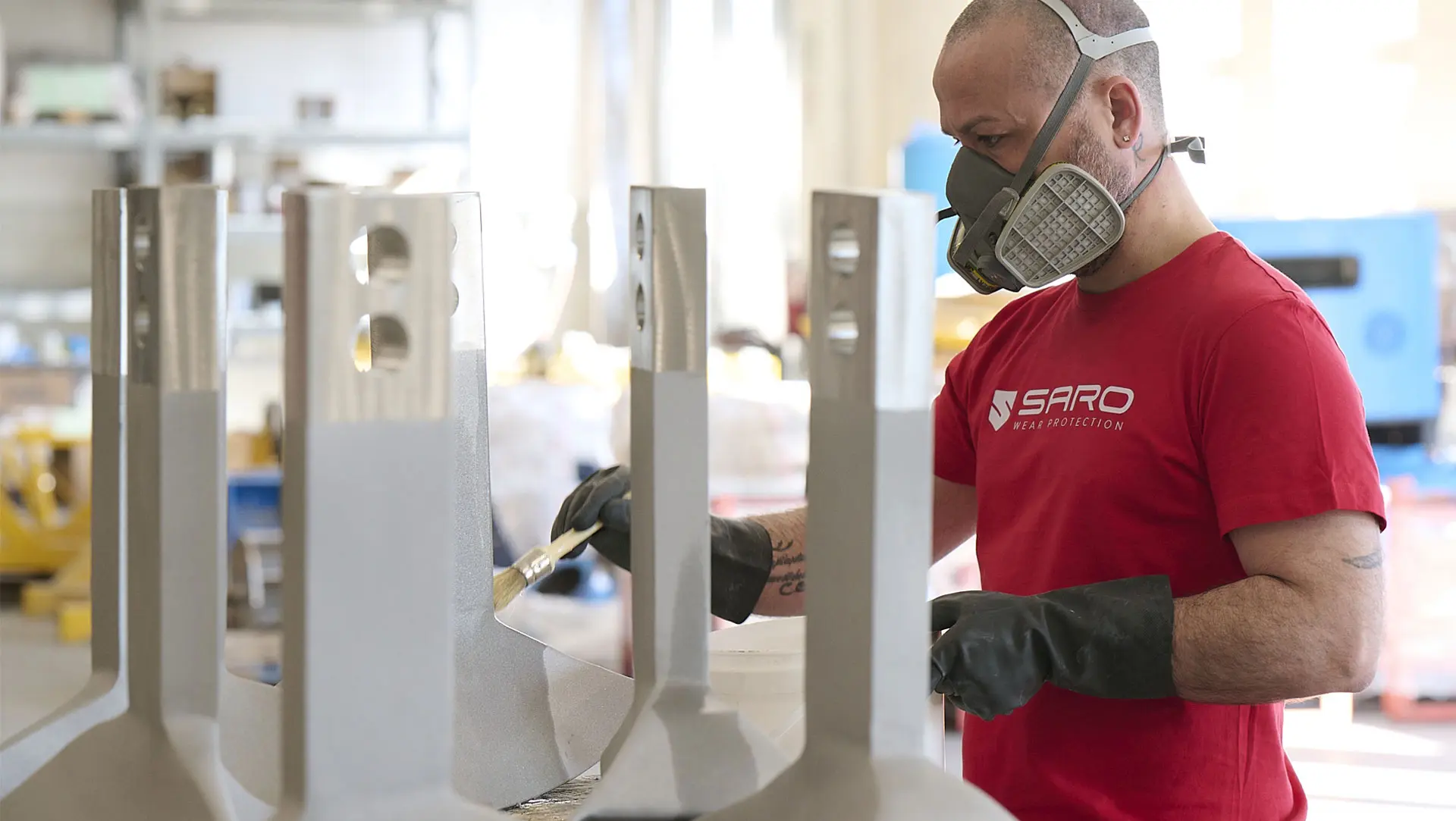
- SARPOL µ50 Brushable epoxy resin loaded with ceramic powder and carbides for protection of worn metal parts
How SARO solutions for internal pipe and elbow linings reduce erosion, plant downtime, and maintenance costs
The SARO experience shows that wear protection in pneumatic conveying is more effective when it is targeted: you start with the sections that generate the most problems (bends, direction changes, high-speed zones) and dimension materials and thicknesses based on the actual stresses. This allows us to build a Tailored anti-wear strategy for each line. In practice, the protection focuses where the particulate works the hardest on the walls, reducing:
- The replacement frequency of pipes and elbows;
- Emergency interventions (patches, welds, urgent replacements);
- Maintenance times, which affect plant availability
Comparison between standard lines and lines with SARO anti-wear solutions
| Appearance | Without specific protections | With SARO wear-resistant solutions (ceramic, rubber + ceramic, reinforced resins) |
| Pipe and curve lengths | Reduced useful life, frequent replacements | Longer service life in critical sections thanks to ceramic coatings and wear-resistant components |
| Maintenance frequency | Recurring interventions, often unscheduled | More predictable maintenance, greater use of scheduled stops |
| Business continuity | Increased risk of blowouts and unexpected downtime | Increased plant availability, reduction of unplanned downtimes |
| Handling of abrasive materials | Rapid erosion of the most stressed areas | Targeted protections sized according to the intensity of wear experienced |
How SARO identifies the custom anti-wear solution for pneumatic conveying
Choosing the right material is important, but it's not enough on its own. In our experience, a wear protection It really works when there’s a clear method behind it. At SARO, we work in phases, and each phase plays a specific role in the final result.
Analysis of wear points
First, let's understand what's really happening on the front line:
- Reporting of materials transported — cement, ashes, glass, sands, recycled materials;
- Check flows, speeds, conditions (dilute or dense phase), and temperatures;
- Mapping of curves and critical sections, also based on maintenance history.
Selection of the most suitable anti-wear technology
Only after that do we move on to the solution:
- Choose from ceramic, rubber + ceramic, and resins; ;
- Definition of thicknesses, formats, laying patterns, and fastening systems;
- Alignment with plant constraints — spaces, access, available downtime window.
Implementation and integration into the plant
The solution takes concrete shape:
- Supply of pre-coated curves and pipes such as SARCER CURVE & PIPES;
- Use of HEXAGON & TETRAGON HOSE ceramic-coated hoses in moving sections;
- Application of coatings with loaded resins.
Monitoring over time
The supply of components is just the starting point.
- Periodic inspection of protected areas to detect wear variations;
- Optimizations or extensions of covered areas based on actual operational data.
FAQ: Pneumatic Conveying of Abrasive Materials and Wear Protection
In which sectors is pneumatic transport of abrasive materials most critical for wear?
The main critical issues emerge in:
- Cement plants
- Coal-fired power plants
- Foundries and metalworking;
- Mining and inert processing plants
- Paper mills and recycling plants for bulk materials with high abrasiveness.
In these contexts, pneumatic lines are often included among protected areas with ceramic coatings, ceramized flexible hoses, and loaded resins from SARO's application portfolio.
Can anti-wear solutions be applied to existing pneumatic conveying lines?
Yes. Existing lines can be protected by:
- Installation of pre-lined components (ceramic bends and pipes);
- Use of ceramized hoses in connecting areas.
- Applications in the field of filled resins on the most worn areas.
The structure of the product families for pneumatic transport and protective coatings allows for intervention on existing systems, minimizing structural modifications.
3. How do you choose the most suitable type of protection for pipes and bends?
The choice depends on parameters such as:
- Material transported and particle size;
- Flow regime (dense or dilute phase);
- Speed and intensity of impacts;
- Temperature and chemical conditions;
- Geometry of lines and installation constraints.
Based on these factors, the lining material (ceramic, rubber + ceramic, reinforced resins), the thickness and size of the inserts, and the fastening system are determined, focusing protection on the truly critical sections.
4. Why combine technical ceramics, rubber, and filled resins in a single anti-wear strategy?
A strategy that combines:
- Technical ceramics in areas subject to high abrasion;
- Rubber + ceramic where impacts and vibrations are present;
- Filled resins for restorations and complex geometries.
allows for protection to be adapted to each line segment. The result is more precise wear control, with fewer unexpected downtimes and more predictable maintenance throughout the plant's lifecycle.
Request a custom anti-wear solution for your pneumatic conveying lines
Reducing wear in a pneumatic conveying line with abrasive materials isn't a matter of luck—it's a matter of diagnosis. You need to know where the line wears the most, curves, high-velocity sections, flexible connections, and match those points with the technology best suited to the actual operating conditions. That's precisely how we work at SARO, where our pneumatic conveying and protective lining product families are the foundation from which we build ceramic linings, hybrid solutions, and loaded resins, all tailor-made for each plant.
To arrive at the right solution without risking either under- or over-sizing, the advice we always give is to start with the data: flow rate and transport speed values, and a history of maintenance interventions, are already an excellent starting point.
If you want a free analysis of your plant's critical points, contact our technical teaman expert will respond to you, quickly.