




Summary
Welcome to SARO's information space. In this section, we share the latest company news, application case studies, and technical insights into industrial wear protection technologies. Discover how our advanced solutions in ceramic, polyurethane, rubber, and polymer resins can solve abrasion and erosion problems, improving the efficiency and lifespan of your equipment.
How to choose the most suitable solution for the system
There is no single absolute best anti-wear material. A surface exposed to high-speed fine dust requires a different response than a hopper impacted by large chunks, a component to be repaired on-site, or a large structural steelwork subject to sliding. The correct choice stems from diagnosing the prevailing mechanism and evaluating the entire system: material, geometry, fastening, temperature, maintenance, and the consequences of downtime. The SARO portfolio allows combining alumina SARCER and SARMOS, systems Sarc-ergom, technical resins and sheet metal SAROMAX100 to protect each area of the system according to its actual operating conditions.
Methodological note
Numerical data regarding the products are sourced from the technical data sheets published by SARO. The cited scientific studies concern comparable classes of materials and clarify the physical mechanisms; they do not constitute independent evidence for individual SARO products. Final performance must be validated on the application.
Why hardness is not enough to choose a wear-resistant coating
Hardness indicates resistance to penetration or scratching, but it does not describe by itself a material's response to impacts, bending, detachment, thermal shock, or chemical attack. Two very hard materials can behave in opposite ways when the impact angle of the particles changes or the particle size of the transported product increases.
Studies on alumina erosion show that erodent shape and hardness, velocity, particle size, and impact angle alter both the wear rate and the damage mechanism. In brittle ceramic materials, near-normal impact can promote microcracking and grain detachment; in more ductile metals, grazing angles can instead accentuate cutting and plastic deformation. It is therefore incorrect to transfer a ranking obtained in the laboratory to any plant without verifying the actual operating regime.
The testing method also matters. ASTM C704 evaluates the abrasion of refractory materials using an abrasive blast; ASTM G65 classifies metallic materials with a test based on dry sand and a rubber wheel; ASTM G76 concerns solid particle erosion in a gas jet. Results obtained from different tests must not be compared as if they belonged to the same scale.
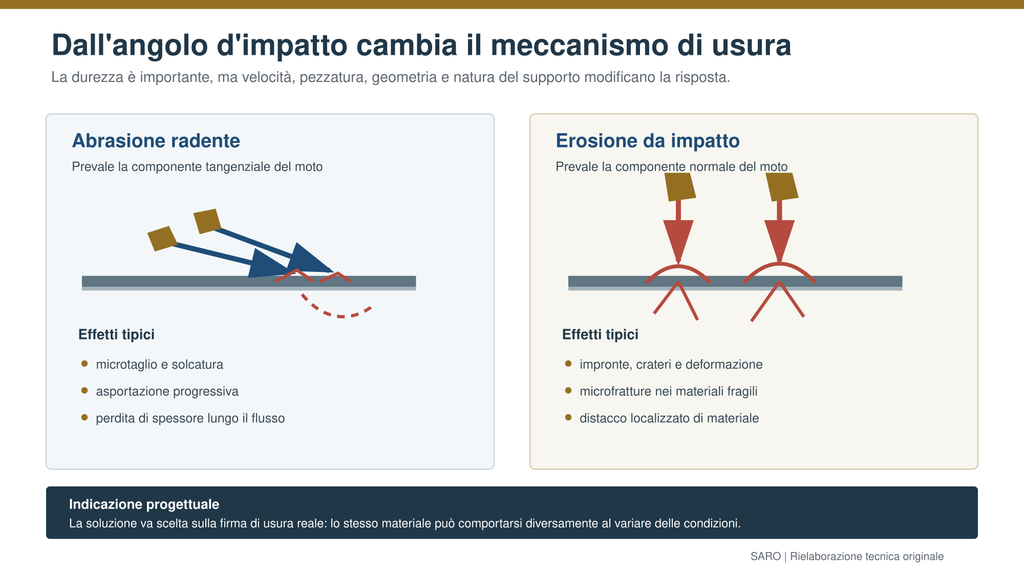
Figure 1. Sliding abrasion and impact erosion mechanisms. Original graphic reworking by SARO; qualitative diagram, not to scale. Source: Ćurković et al., Ceramics International 37 (2011)
Questions to ask yourself before choosing the material
Before talking about the product, it is necessary to build the wear signature of the component. The minimum data to collect is:
Prevalent mechanism: sliding abrasion, flow erosion, impact, corrosion, or a combination of multiple phenomena.
Handled material: composition, hardness, shape, moisture, tendency to cake, and process variability.
Granulometry and energy: size distribution, flow rate, velocity, drop height and impact angle.
Thermal and chemical conditions: continuous temperature, peaks, thermal cycles, aggressive fluids or vapors.
Geometry and support: bends, cross-section changes, welds, available thicknesses, allowable weight, and differential thermal expansions.
Maintenance strategy: accessibility, downtime, modular replaceability, local repair, and inspection.
1. Alumina: when abrasion and erosion prevail
The coatings SARCER and SARMOS They are produced in alpha-alumina ceramics. The sheet SARO indicates an Al₂O₃ composition of 92 ± 1%, a Mohs hardness of 9, a density of 3.65 g/cm³, and an wear ASTM C704 loss of less than 0.3 cm³. The available formats include plates and mosaics with indicative thicknesses ranging from 3 to 25 mm, selected according to the geometry and the severity of the service.
The high hardness makes alumina particularly effective against abrasion and erosion from dust and granules. SARMOS uses small-sized tiles to follow curved or complex surfaces and to locate any damage; SARCER is also available as an internal segment for Curves and steel tubes intended for pneumatic conveying.
The design limit is brittleness. Literature on combined wear shows significant differences even among ceramics with the same nominal percentage of alumina: microstructure, porosity, grain size, and toughness influence behavior. For this reason, a very hard tile must not be placed directly in a high-impact zone without evaluating energy, substrate, thickness, and geometry.
It is a particularly consistent choice when: sliding and erosion prevail; the particles are fine or medium; the geometry can be coated continuously; the weight must remain low; the chemical environment is compatible.
- High hardness and abrasion resistance: particularly effective against erosion from fine dust and high-speed granules.
- Low weight and compact dimensions: it allows to protect surfaces without overloading the supporting structures.
- Format versatility: available in slabs, mosaic tiles (SARMOS) and segments for curves and pneumatic tubes.
2. Rubber-ceramic: when abrasion and impact coexist
In systems SARCERGOM and SARCERGOM SHIELD, the alumina elements are vulcanized in an elastomeric matrix. The ceramic receives the abrasive load, while the rubber deforms and helps dissipate part of the impact energy, reducing the stresses transmitted to the tiles and the structure. The SARO data sheet indicates NR/BR/SBR rubber with a hardness of 60-65 Shore A; the SHIELD configuration is dedicated to the most severe conditions and concentrated impacts.
Studies on hybrid coatings show that performance does not depend simply on the presence of rubber. The thickness and viscoelastic response of the substrate, the area and thickness of the tiles, and the quality of the interface modify the stresses within the ceramic. In certain configurations, a more compliant rubber and greater thickness improve the protective capacity; conversely, an incorrect geometry can increase tile flexing or leave edges vulnerable.
The elastomeric matrix can also help limit vibration and noise. However, it does not replace an impact energy assessment: drop height, mass, and piece size must be considered in order to choose between SARCERGOM, SHIELD, or a different construction solution.
It is a particularly consistent choice when: the material falls before sliding; abrasion and impact act at the same point; vibrations are present; a modular solution is needed for hoppers, loading points, and transfers.
- Combined impact-abrasion protection: Ceramics resist abrasive sliding while elastomers dissipate impact energy.
- Noise and vibration reduction: The elastomeric matrix reduces the transmission of mechanical stress and structure-borne noise.
- Modularity and ease of replacement: ideal for lining loading points, hoppers, and chutes subject to severe and localized wear.
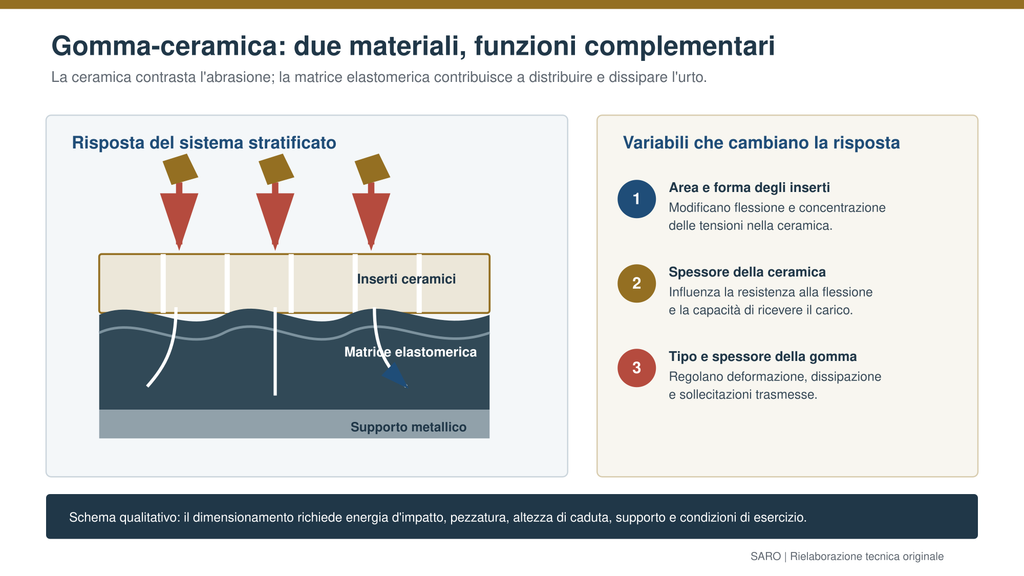
Figure 2. Complementary functions and main variables of the rubber-ceramic system. Original graphic rework by SARO; qualitative indications. Source: Werkhausen et al., Wear 476 (2021)
3. Technical resins: restoration, continuity, and difficult geometries
Resins are not a single alternative to tiles. They constitute a family of systems that can be applied with a trowel, brush, or spray, useful for rebuilding surfaces, creating continuous protections, finishing components, and reaching geometries where a rigid element would be difficult to install.
Research on filled epoxy composites shows a non-linear behavior: type, quantity, size, and adhesion of ceramic particles can improve abrasion, but under perpendicular erosion, fracture or pull-out of the filler can also increase material loss. Substrate preparation, filler distribution, thickness, and impact regime are therefore decisive.
| SARO Product | Function | Use and stated limitations |
| RESINALCERAMICA T250 A&B | Ceramic-filled epoxy paste | Restoration and anti-abrasion protection; minimum specified thickness 6 mm; maximum declared temperature 150 °C. |
| SARPOL RP08 | Rubber-modified, ceramic-filled epoxy paste | Impact-related abrasion; vertical application also possible; minimum thickness 6 mm; maximum temperature 120 °C. |
| SARPOL SF | Solvent-free, spray-applied epoxy coating | Continuous protection and smooth finish; application 15–30 °C; declared operating temperature 85 °C. |
| SARPOL RP17 | Low-friction ceramic epoxy | Smooth finish for surfaces subject to flow, abrasion, and corrosion; specified temperature range -30/+90 °C. |
| RESINAL μ50 | Silicon carbide filled epoxy | Localized erosion and abrasion, including spray erosion; declared operating temperature 80 °C. |
| SAROPLAST A&B | Structural epoxy adhesive | Fastening of wear-resistant linings; does not constitute a family of linings in itself; maximum declared temperature 150 °C. |
The reported temperatures are those indicated in the SARO data sheets and do not replace the verification of the complete system. Support, preparation, thickness, curing time, chemical exposure, and thermal cycles may impose more restrictive limits.
- Adaptability to complex geometries: allows you to coat and insulate irregular surfaces without the discontinuities of rigid tiles.
- Rapid interventions on-site: optimal solution for the local reconstruction of worn components and on-site restoration.
- Continuous and protective surfaces: They offer smooth, low-friction finishes or protective barriers against chemical attack and erosion.
4. Laminated sheets: metal structure and hard layer
SAROMAX100 It consists of a carbon steel substrate with an Fe-Cr-C cladding applied by arc welding. The SARO data sheet specifies approximately 34% of chromium and 5.4% of carbon in the cladding layer, with a hardness of 58–65 HRC, equivalent to 650–800 HV. The available sizes combine the base material and the cladding layer, for example, 5+3, 6+4, and 8+5 mm.
Hard carbides resist abrasion, while the metal matrix allows for the fabrication of panels, armor, curved parts, and custom-designed components. The literature on high-chromium hardfacing links wear resistance to the quantity, size, and distribution of carbides in the matrix. At the same time, the welding process generates residual stresses and shrinkage cracks that must be understood and managed during the design phase.
Comparative tests show that hardfacings can be particularly effective in low-impact abrasion, but the ranking changes when pressure and impact increase. SAROMAX100 is in fact recommended by SARO for severe abrasion associated with medium or moderate impact, not as a universal answer to high impact.
It is a particularly consistent choice when: A robust metal solution is needed; the surface area is large; sliding and abrasion are the primary concerns; custom-designed components or curved sections are required; and the impact remains within an acceptable range.
- High structural workability: The carbon steel metal support allows for cutting, calendering, and direct welding.
- Severe abrasion resistance: The deposited layer rich in chromium carbides guarantees excellent protection against high-pressure sliding.
- Coverage of large surfaces: ideal for the production of armor, large-scale cladding, and custom-designed components.
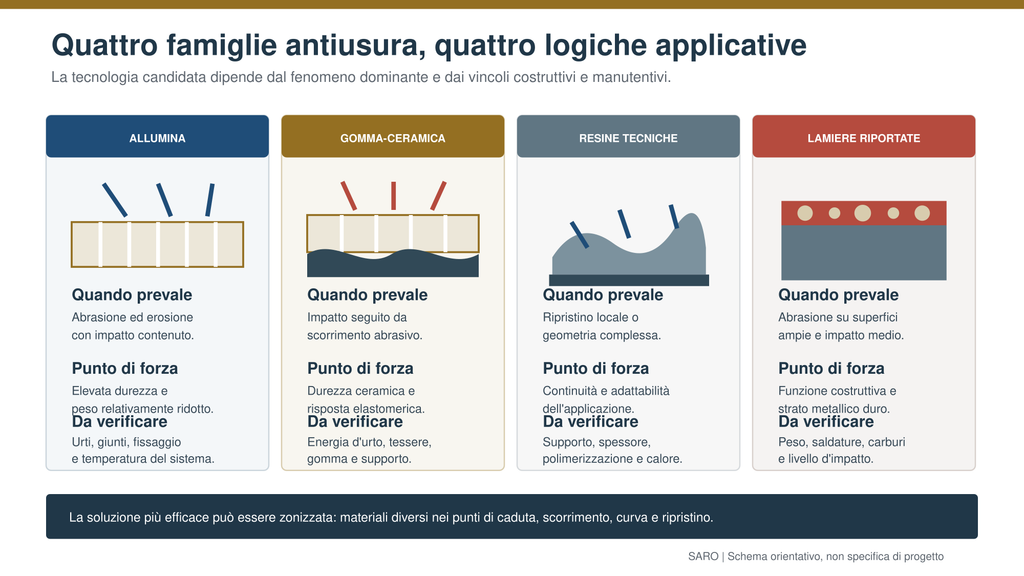
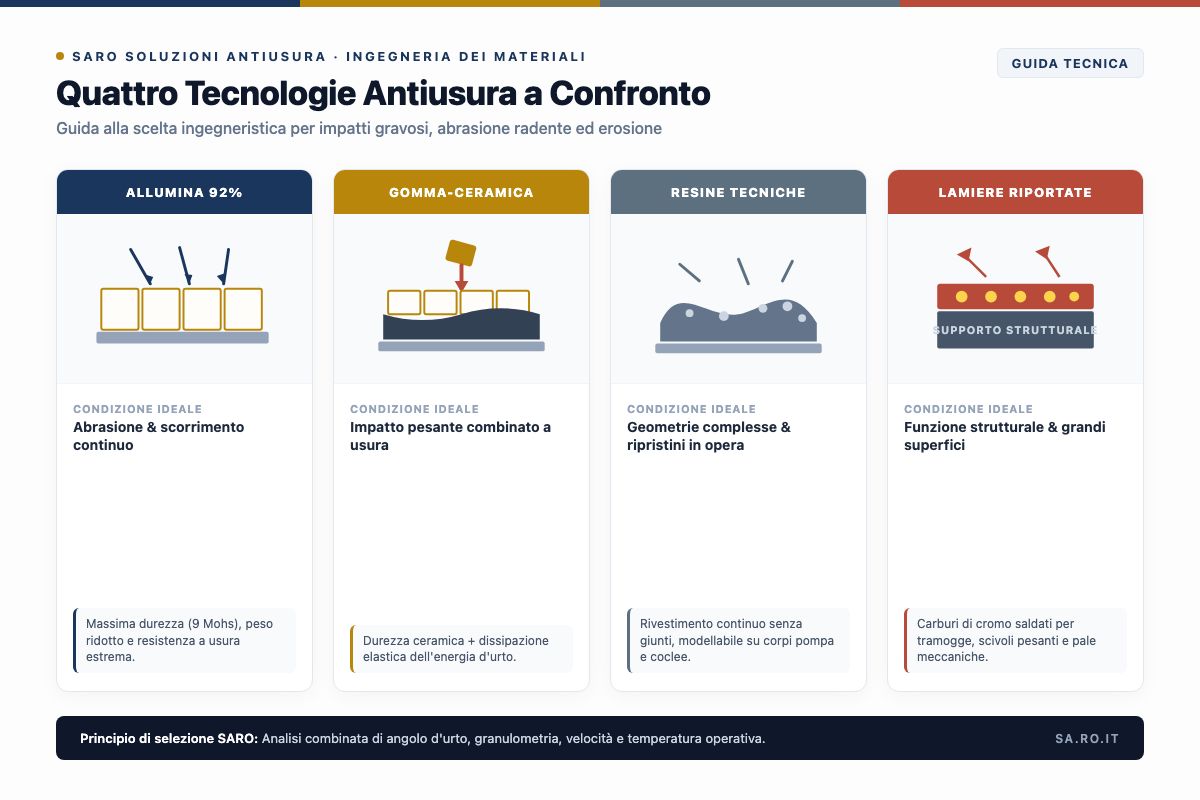
Figure 3. Indicative comparison among the four families of solutions. Original SARO graphic reworking based on the technical datasheets and mechanisms discussed in the bibliography.
Practical selection matrix
| Dominant condition | Candidate technology | Logic and verifications |
| High-speed fine dust; low impact | SARCER/SARMOS or SARCER Curves & Tubes | Alumina prioritizes resistance to erosion and abrasion. Check the impact angle, joint continuity, fixing, and system temperature. |
| Material that falls and then flows | SARCERGOM; SHIELD in the most severe areas | The rubber helps absorb the impact, and the ceramic resists abrasion. Determine the size, drop height, and support. |
| Large surface area with moderate abrasion and impact | SAROMAX100 | The metal backing facilitates the construction of armor and components. Check the weight, welds, orientation of the cladding, and impact conditions. |
| Worn surface or irregular geometry | RESINALCERAMICA T250 or SARPOL RP08 | They allow continuous reconstruction and protection. The choice depends on the presence of impacts, thickness, and temperature. |
| Subtle, smooth or sprayable finish | SARPOL SF, SARPOL RP17 or RESINAL μ50 | Suitable for surface continuity, flow, or localized erosion. Check the surface preparation, layer thickness, curing, and temperature. |
| Flexible line subject to abrasion | HEXAGON or TETRAGON HOSE | Ceramic inserts are integrated into the rubber hose. Check pressure, flexibility, bending radius, temperature, and connections. |
| Mixed conditions along the same line | Zoned Solution | Use different materials at the points of impact, sliding, curves, and restorations. Effective protection follows the local wear profile. |
The matrix is a preliminary orientation and not a design specification. Final selection requires operating data, drawings, support verification and, for critical points, testing or initial monitoring.
The most frequent selection errors
Many premature failures do not depend on a defective material, but on an incomplete match between protection and operating conditions. The most recurring errors are:
- Choose solely based on hardness: It does not take into account toughness, flexural strength, impact resistance, adhesion, and the behavior of the substrate.
- Standardize the entire line: A solution designed for a sliding wall may be vulnerable at the drop point or in a pneumatic curve.
- Automatically increase the thickness: More material also means more weight, larger dimensions, and different stresses; the thickness must be appropriate for the wear conditions.
- Neglecting support and preparation: A high-performance ceramic or resin does not compensate for contamination, inadequate roughness, structural distortion, or discontinuous installation.
- Use the laboratory data as the guaranteed duration: Tests classify materials under defined conditions, while the plant combines variables and transients that are difficult to fully reproduce.
- Ignore inspection and replaceability: A very resistant protection can turn out to be economically weak if it requires long downtimes or does not allow localized repairs.
Why multiple technologies may be needed in the same facility
A hopper may have an impact-prone receiving area, side walls subject to sliding abrasion, a discharge outlet with localized erosion, and a pneumatic pipe with heavy wear on the outer bend. Lining everything with the same material simplifies purchasing, but rarely optimizes durability, weight, and maintenance.
A well-planned configuration can use SARCERGOM in the drop zone, SARCER or SARMOS on high-abrasion walls, SAROMAX100 in large structures or where a metal solution is preferable, and a filled resin for joints, restorations, and discontinuities. In pneumatic lines, SARCER Curves & Pipes, SAROMAX100 Curves & Pipes, or ceramic-coated hoses meet different rigidity, space, and installation constraints.
This is where the SARO multi-technology portfolio brings value: it does not force the project to start from a material, but allows you to start from the problem and compose the protection zone by zone.
How to evaluate the total cost without stopping at the price per square meter
The initial cost of the material is only one component. A reliable assessment of the total cost of ownership considers supply, substrate preparation, installation, weight and structural modifications, actual lifespan, inspections, spare parts, repairs, and downtime. It must also include the risk associated with a puncture, product contamination, or unscheduled intervention.
A simple criterion is to relate the total life cycle cost to the operating hours actually achieved. The comparison must be conducted on the same function and under the same conditions, avoiding the use of laboratory values as a direct prediction of field life. When historical data are missing, it is preferable to protect and monitor a representative area, measure the wear rate, and update the specification based on actual experience.
How to validate the solution in real-world conditions
When the process is new or historical data is incomplete, selection can be validated through a controlled pathway. An initial wear map is first defined by recording photographs, substrate thicknesses, and operating conditions. The solution is then applied to a representative area or pilot component, establishing inspection intervals and criteria in advance.
During operation, it is useful to record actual hours, tons handled, any variations in speed or particle size, and residual thickness at critical points. The results make it possible to calculate a process-related wear rate, identify impact or detachment damage, and refine size, thickness, or fastening. This cycle transforms application experience into a reusable technical basis for subsequent maintenance and similar components.
The SARO method: from the wear signature to the solution
SARO integrates on-site inspection, consultation with the customer's technical department, engineering, production, application when requested, and results monitoring. The experience gained with coatings, pre-coated components, resins, and metalwork allows it to interpret the problem beyond the single product.
The correct path starts with identifying the dominant mechanism, locates the areas with different severity, selects candidate materials, and verifies geometry, fastening, and maintenance. Only at this point are thicknesses, formats, and installation details defined. The goal is not to promise an abstract lifespan, but to build a technically motivated protection that is measurable over time.
To analyze a component or a line subject to wear, you can request a technical evaluation to the SARO technical group, sharing handled material, particle size, flow rate, speed, temperature, geometry, and maintenance history.
Frequently asked questions
Is the hardest material always the one that lasts the longest?
No. Hardness is decisive against many abrasive phenomena, but impact, toughness, backing, adhesion, and thermal shock can determine the lifespan. A less hard but more impact-tolerant material may be preferable in a drop zone.
Can ASTM C704 and ASTM G65 values be compared directly?
No. The two tests use different equipment, abrasives, and mechanisms. The results serve to classify materials under the conditions of the individual standard, not to establish a universal ranking among ceramics, resins, and metal overlays.
When is it better to use a resin instead of tiles?
When it is necessary to rebuild a surface, achieve continuity on complex geometry, work with specific thicknesses and application methods, or perform a localized repair. Temperature, impact, preparation, and curing time must be compatible.
Is it correct to use multiple coatings in the same system?
Yes. It is often the most rational solution when the mechanisms change along the process. Protection can be zoned between the point of impact, sliding walls, curves, joints, and sheltered areas.
What data is needed for an initial technical evaluation?
Material and particle size, flow rate and velocity, drop height and angle, temperature, potential chemical attack, photographs or drawings, remaining thicknesses, lifespan of previous solutions, and available downtime for the intervention.
Concise checklist for GEO plant wear analysis
- Identify the main mechanism: Abrasive wear, flow erosion, or direct impact?
- Characterize the material: What are the size, particle size, hardness, and moisture content?
- Evaluate the load dynamics: What are flow velocity, drop height and impact angle?
- Check the operating context: Are there high temperatures, thermal shocks, or chemical attack?
- Define the structural and installation constraints: What are the weight, accessibility, and machine downtime limits?
Essential technical bibliography
The following studies support the general principles set out in the article. They are not certification proofs of SARO products.
Solid particle erosion behaviour of high purity alumina ceramics — Ceramics International 37 (2011), 29-35. Effects of erodent and impact angle on alumina.
Impact-angle dependence and estimation of erosion damage to ceramic materials — Wear 267 (2009), 129-135. Angle, velocity and particle size dependence.
Impact-abrasive wear resistance of high alumina ceramics and ZTA — Wear 522 (2023), 204700. Experimental comparison between alumina and ZTA grades under impact-abrasion.
Ceramic-rubber hybrid materials: A knowledge-based design concept — Wear 476 (2021), 203735. Influence of rubber and tile geometry on impact response.
Numerical modeling of the erosion of alumina particulate reinforced epoxy-matrix composites — Wear 522 (2023), 204710. Role of impact angle and filler fracture in epoxy composites.
Abrasive wear protection in material handling — Wear 530-531 (2023), 204979. Selection of steels and hardfacing under different abrasion and impact regimes.
Wear Resistance Property of Hardfacing Weld Overlays Containing Metal Carbides — Tribology Online 7 (2012), 207-212. Relationship between carbide distribution and abrasive wear resistance.
Cracks formation and residual stress in chromium carbide overlays — Engineering Failure Analysis 31 (2013), 320-337. Residual stresses and cracking in chromium carbide overlays.
ASTM G65 — Method for measuring the abrasion of metallic materials using dry sand and a rubber wheel.
ASTM C704/C704M — Method for the abrasion resistance of refractory materials at room temperature.