






Summary
Welcome to SARO's information space. In this section, we share the latest company news, application case studies, and technical insights into industrial wear protection technologies. Discover how our advanced solutions in ceramic, polyurethane, rubber, and polymer resins can solve abrasion and erosion problems, improving the efficiency and lifespan of your equipment.
The article presents a technical comparison of ceramized flexible hoses. HEXAGON HOSE e TETRAGON HOSE in SARO and traditional steel piping in lines subject to abrasion. The main focus is on pneumatic transport for highly abrasive materials, on the discharge and suction sides, which represents the natural positioning of these solutions. Applications with sludge, wastewater, or abrasive fluid-solid mixtures can be evaluated on a case-by-case basis, verifying pressure, temperature, chemical composition, and operating conditions. HEXAGON e Tetragon differ in ceramic tile geometry and flexibility: Tetragon offers greater adaptability than HEXAGON, while maintaining comparable wear protection.
When designing abrasive material transport lines, the choice of piping directly determines the plant's lifespan, operational continuity, and medium-term maintenance costs. In the most critical cases, unprotected steel pipes can erode quickly, especially at bends and changes in direction, while solutions such as rigid ceramic pipes and ceramized flexible hoses can significantly increase the service life of components exposed to wear.
In this article, we analyze in detail the behavior of:
- Ceramic-lined flexible hoses HEXAGON HOSE
- Ceramic-lined flexible hoses TETRAGON HOSE
- Traditional steel pipes for abrasive materials, slurries, or fluid-solid mixtures, where technically applicable
with a focus on the typical operating conditions of the plants: pneumatic transport, recycling, inert material treatment, cement plants, steel mills, and lines subject to abrasion where sludges or fluid-solid mixtures may also appear, requiring technical evaluation.
Abrasive Materials and Fluid-Solid Mixtures: Why They Pose a Challenge for Steel Pipes
By abrasive material, we mean a solid or a fluid-solid mixture containing hard particles such as sand, quartz, clinker, coal dust, crushed aggregates, ash, or process residues. In many plants, these materials are conveyed in continuous operation, often over multiple shifts, with speed and flow rates that concentrate abrasive stresses on bends, reductions in section, and couplings, making them critical areas of wear and potential line downtime.
The main stresses acting on the pipes are:
- Abrasion continuous rubbing of solid particles on the internal walls.
- Erosion impact of high-speed particles, especially on curves and changes of direction.
- Corrosion or chemical attack: possible additional contribution when the transported material contains moisture, wastewater, or chemically active agents.
In this context, unprotected steel pipes typically show:
- Rapid thinning of the interior walls.
- Crater formation and scratches on the curves.
- Sudden perforations with material losses, plant shutdowns, and emergency interventions.
This highlights the need to evaluate dedicated wear protection solutions, chosen based on the actual operating conditions and the criticality of the most exposed sections of the line.
What are HEXAGON and TETRAGON ceramized hoses?
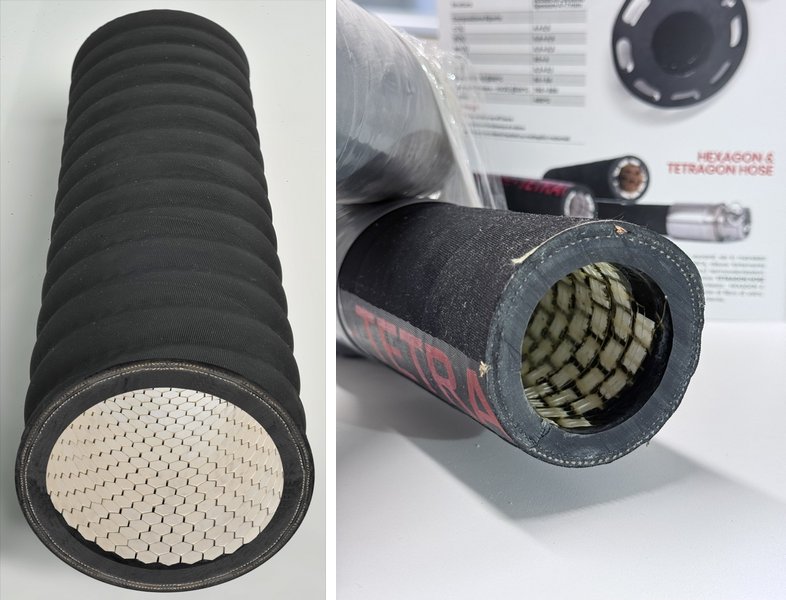
The tubes HEXAGON and TETRAGON HOSE In SARO, these are ceramized flexible pipes where technical ceramic inserts are embedded in rubber, thus combining wear resistance with the ability to absorb shocks and vibrations. They are solutions developed for the pneumatic transport for highly abrasive materials, in both discharge and suction. The possible use with abrasive sludges, wastewater, or slurries requires specific verification of compatibility with regard to pressure, temperature, fluid chemistry, and connection method.
On a structural level:
- The body It is made of wear-resistant and anti-static SBR/NBR rubber.
- The structure includes a steel spiral and a copper wire mesh for electrical continuity (where required).
- Inside, a mosaic of ceramic inserts in hexagonal geometryHEXAGON) squareTetragonconstitutes the true anti-wear layer.
For a deeper understanding of Technical ceramics employed in these coatings, you can consult the SARO sheets dedicated to SARCER, SARMOS and to ceramic solutions for lines subject to abrasion.
Differences between HEXAGON and TETRAGON in the transport of abrasive materials
Is HEXAGON HOSE what TETRAGON HOSE they are designed as wear-resistant ceramic-lined hoses, but they have functional differences that can guide the choice when dealing with more or less abrasive materials and different installation constraints.
Ceramic tile geometry
HEXAGON HOSE Uses a hexagonal honeycomb mosaic, which maximizes coverage and continuity of the internal lining.
TETRAGON HOSE Use a square mosaic with tetragonal geometric ceramic inserts.
Both solutions guarantee an interior surface protected by ceramic and are designed to reduce wear, maintenance, and clogging risks in lines with highly abrasive materials.
Flexibility and minimum bending radius
In terms of flexibility, TETRAGON HOSE it was developed to offer even greater ease of installation compared to HEXAGON HOSE, with equal nominal diameter. The minimum bending radius data reported in the technical tables help assess adaptability to tight geometries, a key aspect in lines with space constraints, connections to rigid components, and sections subject to vibrations.
For dimensional details on diameters, weights, minimum radii, and ceramic thicknesses, you can refer to the Product sheet HEXAGON & TETRAGON HOSE. The technical values to consider during the verification phase include a nominal operating pressure of 10 bar, a nominal bursting pressure of 30 bar, and an operating temperature range of -30/+70 °C.
Durability and wear performance
Both families of ceramic-lined hoses aim for a significantly longer lifespan compared to traditional wear-resistant rubber hoses. The SARO data sheet indicates a lifespan 20 times greater than that of wear-resistant rubber hose in highly abrasive applications. This figure should not be read as a direct and universal comparison with steel, but as a performance indicator relative to rubber. In lines conveying abrasive materials, a longer hose life reduces the frequency of replacement for the most stressed sections and limits variations in the internal diameter due to progressive wear.
Technical Comparison: HEXAGON vs TETRAGON vs Steel Pipes
The following table summarizes the main aspects to consider when comparing flexible ceramic pipes and steel pipes for lines carrying abrasive materials. For applications with liquids, sludges, or wastewater, a nominal operating pressure of 10 bar, a temperature of -30/+70 °C, and chemical compatibility must be verified before making a choice.
| Appearance | HEXAGON HOSE | TETRAGON HOSE | Unprotected steel pipes |
| Internal structure | Hexagonal honeycomb ceramic mosaic | Square ceramic tile | Uniform metal wall |
| Flexibility | Elevated, suitable for movable parts | Even more flexible, suitable for tighter radii | Limited; curves made with welded seams or flanges |
| Abrasion resistance | Very high with materials containing hard solids | Very high, comparable to HEXAGON | Limited if the transported material is very abrasive |
| Operating time | Up to approximately 20x compared to abrasion-resistant rubber | Comparable to HEXAGON, with a possible reduction of 10–15% | Reduced, especially on curves and changes of direction |
| Shock/Vibration Management | Rubber + ceramic, good tolerance | Rubber + ceramic, good tolerance | Subject to thinning, localized erosion, and risk of perforation |
| Maintenance | Less frequent substitutions on critical features | Less frequent substitutions on critical features | Frequent replacements and possible emergency interventions |
| Engineering adaptability | Moving parts, joints, and bypasses | Complex layouts and small spaces | Straight sections and large radii of curvature |
Advantages of ceramic pipes in transporting abrasive materials
Whether talking about rigid ceramic pipes (pre-lined components) or ceramic-lined flexible hoses like HEXAGON and TETRAGON, the benefits over unprotected steel become apparent in abrasive transport contexts, especially where curves, fittings, and changes in direction concentrate wear.
Longer duration and section stability
Thanks to the high hardness of technical ceramics based on alumina, the inner wall of the pipes maintains its thickness and geometry much better over time compared to unprotected steel. This results in:
- Risk reduction of perforations and material leaks.
- Minor deformation of the internal section, with more stable flow.
- Minor accumulation in adherent solids, thanks to the smooth ceramic surface.
To see how these principles are also applied to the lines of pneumatic transport For abrasive materials, you can consult the dedicated guide on pneumatic transport of abrasive materials.
Maintenance intervention reduction
The longer lifespan of ceramic anti-wear solutions allows for extended intervals between interventions, concentrating maintenance activities during scheduled downtime. In case of localized damage on compatible components, it is possible to consider filled resin systems, such as RESINALCERAMICA® T250 A&B; o SARPOL RP08, to restore missing volumes or reinforce critical points. The choice, however, must be verified based on support, surface preparation, temperature, presence of liquids, and chemical conditions.
Greater operational continuity
Fewer wear-related failures mean more available operating hours and less risk of unexpected downtime, particularly on lines pneumatic transport and in departments handling abrasive materials. In a context where operational continuity directly impacts productivity and total operating costs (Total Cost of Ownership), the choice of ceramic pipes and ceramized flexible hoses becomes a strategic element in the design of the lines.
Where does it make sense to use HEXAGON, TETRAGON, and steel tubes?
There is no single solution that is valid for every installation point: correct sizing requires analyzing the material being conveyed, the line geometry, and the process conditions. SARO's experience provides some useful guidelines when dealing with abrasive materials in pneumatic transport fluid-solid mixtures to be carefully evaluated.
When to prefer HEXAGON HOSE
Ceramic hoses HEXAGON HOSE are particularly indicated when
- The material contains a high fraction of solids with high hardness (sands, quartz, clinker, coal dust, aggregates).
- The lines are subject to intense wear in the discharge and suction sections.
- Geometry requires flexibility, but with non-extreme radii of curvature.
Under these conditions, the rubber + hexagonal honeycomb mosaic combination offers a good compromise between durability and ease of installation.
When to prefer TETRAGON HOSE
Ceramic-lined hoses TETRAGON HOSE They are born to offer even more flexibility, maintaining wear performance comparable to HEXAGON. They are particularly advantageous when:
- The line requires tight turns or frequent changes in direction.
- Are present flexible connections between rigid sections, machines, or components subject to vibration.
- Space available in the plant is limited and requires a reduced minimum bending radius.
The adoption of TETRAGON HOSE it can reduce the number of joints, flanges, and rigid sections, with benefits in terms of line continuity, ease of installation, and reduction of critical wear points.
Where steel still makes sense
Unprotected steel pipes can remain a viable solution in some sections:
- Lines with low-abrasion materials or low hard solid content.
- Traits easily inspectable and replaceable straight lines.
- Sections no criticisms from the perspective of the impact on plant operation.
In all other cases, the introduction of ceramic pipes (pre-lined elbows, rigid ceramic pipes, rubber + ceramic) or ceramized flexible hoses can lead to a significant reduction in overall maintenance costs, if confirmed by a technical assessment of the application.
Integration with other SARO anti-wear systems
In practice, the most effective solution for an abrasive line is often an integrated system that combines various anti-wear materials and technologies. The SARO approach involves targeted intervention at the most critical points of the line, using the most suitable technology for each section.
Pre-lined curves and rigid ceramic pipes
In areas where the flow direction changes abruptly, the adoption of pre-coated components such as SARCER BENDS & PIPES allows ceramic to be concentrated where the material works hardest on the walls. These elements, designed by SARO for pneumatic conveying lines with wear problems, can be combined upstream and downstream with flexible sections HEXAGON o Tetragon to manage vibrations and mechanical settling of the line.
Filled resins for restoration
For complex geometries, pump housings, or isolated wear points, the use of filled resins such as RESINALCERAMICA® T250 A&B, RESINAL μ50 The SARPOL RP08 can enable localized repairs. These solutions integrate with ceramic pipes and ceramic-lined hoses when application conditions are compatible; the evaluation must consider surface preparation, operating temperature, presence of liquids, and chemical aggression.
For an overview of the main anti-wear product families available, you can explore the section dedicated to anti-wear protection products.
Method of choice: how to size pipes for abrasion-prone lines
Choosing between HEXAGON, TETRAGON, and steel pipes doesn't just mean comparing materials, but applying a structured working method that takes into account real operating conditions. The path followed by SARO in analyzing lines subject to abrasion can be summarized in four phases.
Problem analysis
Identification of carried material: nature of the solid or fluid-solid mixture, percentage of solids, grain size.
Relief of flows, speeds, temperatures, operating pressures, and, if present, liquids or effluents, chemical composition.
Critical points mapping curves, cross-section variations, joints, and sections prone to clogging.
Choice of anti-wear technology
Assessment of the need rigid ceramic pipes, flexible ceramized pipes, or hybrid combinations.
Definition in ceramic thicknesses, formats, and laying patterns depending on the expected wear intensity.
Alignment with the available plant constraints and downtime windows.
An example of how this approach is applied to the transport of solid materials is described in the method illustrated on the page How we work.
Implementation and integration into the plant
Supply of pre-lined ceramic bends and pipes for areas of maximum impact or abrasion.
Installation of ceramized hoses HEXAGON & TETRAGON in the moving parts and in the critical connections.
Possible application of filled resins to complete the protection of complex geometries.
Monitoring and optimization
Periodic checks on the condition of the protections and internal walls.
Extension or optimization of paved areas based on actual operating data.
This approach allows for the construction of a custom anti-wear strategy for each line of abrasive material transport, avoiding both under-dimensioning and over-dimensioning.
Practical guidelines for installations
Many plants that transport abrasive materials (cement plants, steel mills, quarries, recycling, aggregate processing, and some lines with sludge or fluid-solid mixtures) share recurring characteristics: layouts that are not always recent, space constraints, and the need to minimize unscheduled downtime as much as possible. In these contexts, the targeted introduction of ceramic-lined flexible hoses in the most stressed sections can help achieve a good balance between initial investment and a reduction in the total cost of ownership.Total Cost of Ownership).
FAQ: Ceramic Tubes for Abrasive Materials
Ceramic pipes are more suitable than steel pipes when:
The choice of ceramic pipes is recommended when steel pipes undergo rapid wear due to materials with a high percentage of hard solids (sand, quartz, clinker, coal dust, aggregates). Typical signs include frequent perforations on bends, reduction in thickness, and unplanned plant shutdowns, where ceramic solutions significantly increase the service life of the pipes.
What is the main difference between rigid ceramic pipes and HEXAGON/TETRAGON ceramic flexible pipes?
Rigid ceramic pipes are pre-lined elements (bends, straight sections, fittings) designed for points of maximum wear with a defined geometry. Ceramized flexible pipes HEXAGON e Tetragon They combine the resistance of ceramic with the flexibility of rubber, and are indicated for flexible sections, machine connections, and areas where tight bending radii are needed, while adhering to the pressure and temperature limits specified on the product sheet.
How to choose between HEXAGON and TETRAGON ceramic hoses?
In general, HEXAGON HOSE It is the benchmark solution for lines subject to abrasion with standard flexibility requirements and strong internal wear. TETRAGON HOSE It is indicated when the system requires even more flexibility (complex layouts, tight spaces, close curves), maintaining comparable wear resistance to HEXAGON.
What advantage do ceramic hoses offer over traditional rubber?
In highly abrasive applications, ceramized hoses can achieve service lives up to approximately 20 times longer than those of purely abrasion-resistant rubber hoses, reducing replacements and emergency stock. In lines carrying abrasive materials, this reduces the frequency of replacement for critical sections and improves the predictability of maintenance interventions.
How can I figure out the correct combination of ceramic pipes for my system?
The choice between steel pipes, rigid ceramic pipes, and flexible ceramized pipes requires an analysis of the material being transported (composition, particle size, flow rates) and a mapping of critical points in the line (bends, reductions, connections to machinery). In the presence of liquids, sludges, or effluents, the nominal operating pressure, temperature (-30/+70 °C), and chemical compatibility must also be verified. The SARO working method involves a structured path of diagnosis and proposal of customized anti-wear solutions for each system.
Request a technical comparison of your abrasive material pipes
Reducing wear in abrasive material transport systems is not just a matter of material, but of accurate diagnosis of critical points and targeted choice among steel pipes, ceramic pipes, and ceramized flexible hoses. The SARO technical team can support you in comparing HEXAGON HOSE, TETRAGON HOSE and rigid ceramic solutions, starting from your plant's real data.
For an initial analysis, you can:
- Prepare photos of the most worn areas.
- Gather Indicative flows, composition of transported material, pressure, temperature, and frequency of replacement interventions.
If you want to discuss a custom anti-wear solution for your abrasive material transport lines, you can contact the technical team directly through the page Contact SARO.