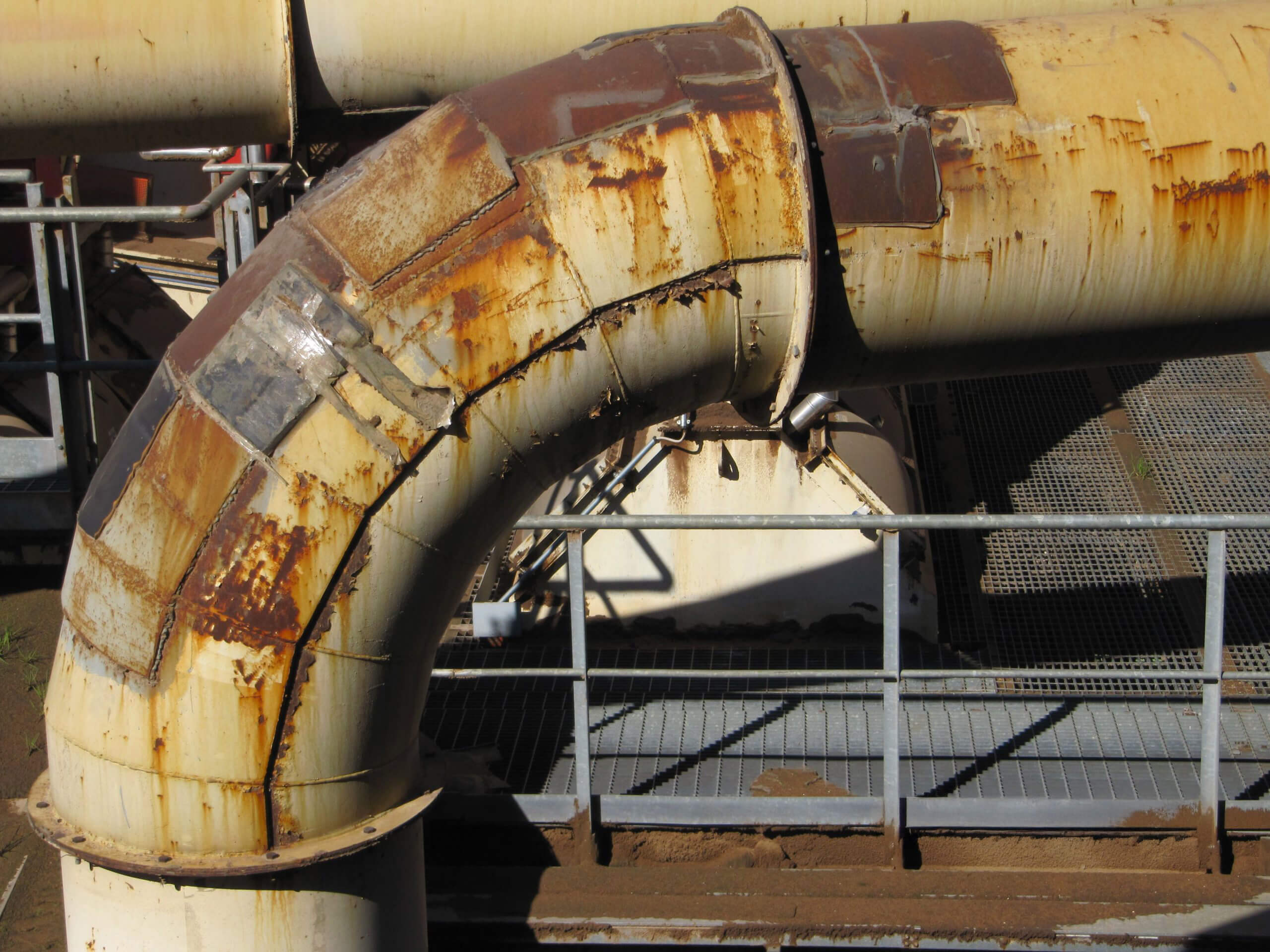
In industrial lines transporting powders, granules, slurries, or other highly abrasive materials, protecting piping and components from wear is essential to reduce leaks, unplanned downtime, and maintenance costs. However, the choice cannot be based on a standard solution or an “absolute best” material, but on the diagnosis of the prevailing phenomenon: abrasion, erosion, impact, temperature, chemical attack, and line geometry. In this article, we analyze when internal lining of pipes is truly useful, when it is more correct to talk about dedicated wear-resistant components, and what technologies to consider: ceramic/alumina, technical rubber + ceramic pipes for pneumatic conveying, and filled resins for repairs and complex geometries.
In industrial plants that handle abrasive materials, piping and line components are exposed to a progressive degradation which is rarely uniform. Wear tends to concentrate at points where the flow changes direction, accelerates, impacts, or generates turbulence: bends, fittings, diversions, reductions, drop points, and transition zones.
When transporting mineral powders, clinker, ashes, sands, granules, sludges, or other aggressive materials, the internal wall of components can thin to the point of causing leaks, boreholes, and urgent repairs. In these cases, protecting the metal not only increases the component's lifespan but also improves plant operational continuity and makes maintenance more predictable.
This is why it's useful to make a clear technical distinction: in some cases the correct solution is a anti-wear lining, in others it is more appropriate to adopt a Wear-resistant component, designed to work directly in those operating conditions.
Internal pipe lining becomes a sensible technical choice when the main problem concerns wear of the component's inner surface and when operating conditions make it useful to add wear protection designed for the critical point.
In general, it's advisable to evaluate it when one or more of these conditions are present:
The point, however, is not to cover everything up. The point is to understand where, come e with what technology It makes sense to intervene.
When material changes trajectory and impacts the wall at high velocities, erosion can concentrate very rapidly in bends, branches, confluences, and flow diversion zones.
In straight sections, the dominant mechanism can be more gradual but constant. Continuous contact of the material with the inner surface leads to progressive wear of the metal and deterioration of flow conditions.
When the material is coarse, discontinuous, or dense, wear is not solely abrasive. In these cases, impacts, concentrated loads, and mechanical stresses also come into play, requiring protection suited to the actual phenomenon.
A perforation not only incurs replacement costs. It can lead to product loss, dust dispersion, unexpected downtime, extraordinary cleaning, risks for operators, and overall plant inefficiency.
In the protection of piping and components, there is no one-size-fits-all solution. The correct choice depends on a set of operational and construction variables:
According to SARO Wear Protection, the performance of wear protection depends as much on the material as on the quality of the diagnosis and design. A valid technology, if applied in the wrong place or in the wrong way, will not yield the expected result.
When the prevailing mechanism is abrasion or erosion by fine particles at high speed, the technical ceramics an alumina base often represents one of the most effective solutions for protecting rigid components.
Its high hardness makes it suitable for applications where unprotected steel would wear out quickly. Configurations can include tiles, mosaics, or ceramic inserts, depending on the geometry and wear profile.
This solution is mainly used in:
In the SARO context, the alumina coating is not treated as a standard response but as a protection to be sized based on thickness, format, and actual operating conditions.
In these applications, the rubber + ceramic combination should not be described as a normal internal lining applied to standard piping. It is more accurate to speak, instead, of anti-wear technical tubes dedicated, like HEXAGON & TETRAGON HOSE, in which ceramic inserts are integrated into the rubber hose structure to offer high operational abrasion resistance.
This product architecture is particularly useful when the line requires:
More than interior cladding in the traditional sense, in this case we are talking about full anti-wear component, designed to work as a dedicated technical pipe. The ceramic contributes to surface resistance, while the rubber participates in the overall structure and functionality of the system.
For SARO, this distinction is substantial: applying wear-resistant coating to a component is one thing, but a specific construction solution for the pneumatic conveying.
Polymer resins filled with anti-wear components are particularly useful for localized repairs, protection of irregular surfaces, or on-site interventions with limited downtime.
Filled resins are an effective solution in many repair applications or for complex geometries, but they do not automatically replace anti-wear components or systems specifically designed for more demanding operating conditions.
They can be effective when the problem concerns:
Their main advantage is the ability to adapt to the component's geometry. Their effectiveness, however, depends on very specific factors: substrate preparation, applied thickness, type of stress, temperature, and operating conditions.
In SARO optics, resin-filled material should not be presented as a universal shortcut, but as a technology to be used where it offers a real advantage.
| Type | Main function | Scope of use | Application Notes |
|---|---|---|---|
| Ceramics / Alumina | Wear-resistant coating for rigid components | Curves, fittings, pipes, and surfaces subject to abrasion or erosion | To be sized based on geometry, wear, and fastening system |
| Abrasion-resistant rubber + ceramic pipes | Dedicated technical component, not simple lining | Pneumatic conveying with high wear resistance and flexibility requirements | Specific solution such as HEXAGON & TETRAGON HOSE |
| Filled resins | Restoration and field protection | Complex geometries, irregular surfaces, localized interventions | Useful where adaptability and reduced downtime are needed |
| Unprotected steel | Base reference | Any unprotected line | It is not an anti-wear solution. |
For SARO Wear Protection, the starting point is not the product, but the problem. The goal is not to propose a technology in abstract, but to identify the real wear mechanism and select the solution most consistent with the specific point of the plant.
The starting point is the available data:
Abrasion, erosion, impact, or combined wear: each phenomenon requires a different logic.
Only afterwards is it assessed whether the case requires:
Thickness, format, support, fastening, installation method, and accessibility directly impact durability.
Where possible, observing performance in operation helps to improve protection and refine subsequent interventions.
Every industrial sector presents different combinations of abrasion, erosion, impact, temperature, and plant criticality. For this reason, it is not correct to rigidly associate a sector with a single technology. Instead, it is more useful to examine the recurring problems in each production context and evaluate, on a case-by-case basis, which anti-wear protection is most appropriate.
In the cement industry and limestone processing plants, conveyor lines are frequently subjected to intense wear due to abrasive fine dusts such as cement, clinker, and raw meal. In these contexts, the problem is most pronounced in high-speed sections, bends, and points where the flow changes direction.
Here, ceramic/alumina coating for rigid components often represents an effective solution, especially when the goal is to increase durability against localized abrasion and erosion. However, the choice always depends on the transport speed, the geometry of the section, and the actual operating conditions.
In the steel industry, one of the contexts in which wear plays a particularly critical role is the pneumatic conveying of materials destined for the EAF, such as coal dust, plastics, and lime. In these applications, the problem concerns not only the final injection point into the furnace, but the entire system: material reception, storage, dosing, conveying, and delivery, often along lines that can extend for several hundred meters from the unloading point to the EAF.
In this type of system, wear must be assessed along the entire line because transport speed, material abrasiveness, path geometry, changes in direction, and operational continuity can create localized criticalities on pipes, bends, fittings, and process components. For this reason, wear protection cannot be set up generically; each critical point must be analyzed individually to determine whether the problem requires a coating for rigid components, a dedicated technical pipe for pneumatic transport, or restoration work on specific areas.
In mining and mineral processing, lines are often exposed to high-density materials, heterogeneous particle sizes, and high flow rates. This means that, in addition to abrasion, impact, trajectory changes, and concentrated wear at impact points become significant.
In these cases, the distinction between internal lining, dedicated component, and repair is particularly important. Depending on the point on the line, it may be more consistent to adopt a ceramic lining, a specific anti-wear component, or localized protection on selected areas.
In recycling and waste-to-energy plants, one of the most critical aspects is the heterogeneity of the treated material. Refuse-derived fuel (RDF), glass, paper, mixed waste, sludge, and other materials can generate highly variable wear conditions, often aggravated by complex geometries and maintenance constraints.
In these systems, the coexistence of diverse needs within the same system is common: rigid components to protect against abrasion, irregular surfaces to restore, and areas where the problem must be addressed with targeted interventions rather than complete replacements.
In pneumatic conveying of abrasive materials, avoiding simplifications is crucial. An internal lining in the traditional sense is not always the correct theme. In many applications, especially where wear resistance and installation flexibility are needed, it is more appropriate to adopt a dedicated component such as an anti-wear technical pipe.
It is in this area that solutions such as HEXAGON & TETRAGON HOSE, where the rubber + ceramic combination should not be read as simple lining, but as a specific constructive architecture of the pipe.
In process plants, even within the same facility, areas subject to very different wear phenomena can coexist. For this reason, effective protection isn't born from a generic industry classification, but from analyzing the individual component: where it is located, how it operates, what material it interacts with, and which degradation mechanism prevails.
For SARO, this is the decisive step: not to start from the sector in the abstract, but to use it as context to arrive at the real diagnosis of the critical point.
One of the most common mistakes is treating all solutions as if they belong to the same category. Not everything that protects against wear is an “internal coating” in the strict sense.
Other common mistakes include:
Per SARO, avoiding these mistakes means establishing more credible, effective, and sustainable protection over time.
When wear of the internal surface of the component is the main problem and a properly designed coating can increase lifespan and reduce downtime costs. However, cost-effectiveness must be evaluated on a case-by-case basis, considering the material being transported, speed, temperature, geometry, and criticality of the point.
Not in the traditional sense of the term. In this context, it is more accurate to speak of a dedicated anti-wear technical tube, such as HEXAGON & TETRAGON HOSE, and not of simple lining applied to a standard pipe.
It depends on the wear phenomenon, the component's geometry, the type of line, and the operating constraints. There is no universally valid answer. In some cases, the correct choice is an alumina coating on a rigid component; in others, a dedicated technical tube or a repair with filled resin is more appropriate.
The most evident benefits are found in sectors where abrasion, erosion, and impact directly affect operational continuity: cement plants, limestone quarries, steel mills, foundries, mining, mineral processing, recycling, waste-to-energy plants, and generally plants that handle abrasive or highly aggressive materials. However, in this case too, it is not the sector alone that determines the solution, but the type of wear present at each specific point in the line.
No. Each sector presents recurring conditions, but the choice cannot be automatic. A cement plant, a steel mill, or a recycling plant can have very different critical issues, and even within the same plant, points requiring different technologies can coexist.
Yes, in many cases it is possible to intervene on already installed components, both with specific linings and with on-site repairs. The solution must be evaluated based on accessibility, available downtime, the condition of the component, and the type of wear to combat.
The duration depends on operating conditions, design quality, and consistency between the problem and the adopted technology. Rather than giving a standard value, it is more accurate to estimate the useful life based on similar cases, application data, and observation of in-service behavior.
Yes, and it is often the most rational choice. The same plant can have rigid components to be coated with ceramic, pneumatic conveying lines that require dedicated technical pipes, and specific areas where it is more advantageous to use filled resins for repair.
When a line shows premature wear on pipes, bends, fittings, or transport components, the first useful step is not to immediately choose a material, but to understand what phenomenon is causing the degradation and what type of protection is most consistent with that part of the system.
For this SARO Wear Protection, the assessment is based on real operating data: transported material, speed, line geometry, temperature, criticality of the point, and wear history. Only after this analysis can it be determined if an internal lining, a dedicated wear-resistant component, or targeted restoration is needed.
If photos of worn-out points, process data, or maintenance history are already available, these elements allow for the establishment of a faster and more precise evaluation.




